
Blueprint for Sustained Performance Issue 8: Role Modelling Under Pressure
Source: Deb Bailey Ltd
Blueprint for Sustained Performance
Issue 8: Role Modelling Under Pressure
Blueprint Lens: Culture and Performance Standards. Pressure does not create culture. It reveals the behavioural standards leaders are truly reinforcing. Inconsistency at the top eventually becomes inconsistency in delivery, communication, accountability, and performance.
When leadership depth is uneven, culture becomes inconsistent.
In Issue Seven, we explored how growth exposes gaps in capability and those gaps show up not just in decision making, but in behaviour.
And behaviour, especially under pressure, becomes the real signal of what is acceptable.
Behaviour Becomes The Signal
In construction, standards are often visible:
Quality of build
Site safety
Programme delivery
Cost control
What is less visible, but just as powerful, is the behavioural standards and that is set at the top.
The Standards Leaders Reinforce
Leaders often believe culture is shaped by policies or values statements but we have all been in organisations where what you read on the wall is not what you experience as you move around the business.
In reality, culture is shaped by the behavioural patterns leaders repeatedly tolerate and reinforce under pressure.
The Behaviour Reinforcement Cycle
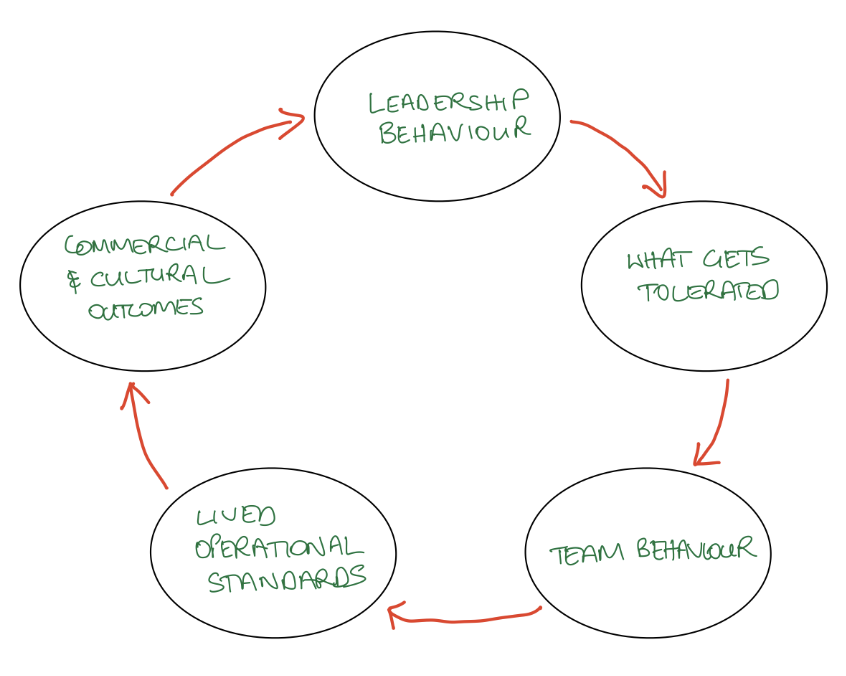
(Source: Deb Bailey Ltd – The Behaviour Reinforcement Cycle)
Pressure reveals the standards organisations ultimately live by and the cycle becomes most visible when pressure increases.
What happens when deadlines tighten, do you cut corners on conversations?
What about when margins compress, do you compromise on behaviour in some way, do you stop doing the things that you said were important for your people and ultimately your business?
The Costs of What You Quietly Tolerate
When a senior performer delivers financially but damages team morale, what do you do?
I worked with a business where a common phrase that was used for the justification of poor behaviour of a particular senior team member was “you can't make an omelette without breaking a few eggs.” Meaning, they were tolerating the poor behaviour because this leader delivered very well on other parts of the job.
However, it was costing them in employee turnover and low engagement in the part of the business this leader was responsible for.
It also caused confusion about some of the behavioural standards set by the organisation because it clearly did not apply to the leaders at the top.
Now, they knew this behaviour wasn't what they wanted, they just didn't know how to go about having the conversation and how this leader could be helped without demotivating them. But, they knew that helping this leader make some changes that were going to be beneficial to all was what was needed. In case you are wondering, mission was accomplished and the leader now has one of the most engaged teams in that business. Unhelpful behaviours can be changed if it's approached the right way.
Inconsistency Spreads
Your team watches what you and the rest of the SLT reinforce.
If you avoid difficult conversations, your leaders will too. If you override process when it suits you, standards weaken everywhere else.
Inconsistent behaviour at the senior level creates operational inconsistency and confusion, and operational inconsistency is going to cost you money.
Role modelling is not about being perfect. It is about being consistent and aligned across the senior team. Say what you do and do what you say, we have all heard that mantra.
If the culture you see emerging does not match your intention, examine what you are modelling.
Because what you tolerate or are inconsistent with, becomes the norm.
A Final Thought
Culture is shaped most clearly in difficult moments, not in vision statements and not in town halls alone (note: if you do these things and they are consistent with the overall behaviour of the SLT, especially when the pressure is on, keep doing them).
Culture is shaped in how you respond to mistakes, in how you hold standards and in how you speak about and to others.
If the culture you see emerging does not match your intention, examine what you and the rest of the SLT are modelling.
Because behaviour at the top always travels downward.
Need Some Help?

If these themes are raising useful questions for you or your senior team, that is often where the real work begins.
Because sustainable performance is rarely just operational. More often, it reflects how leadership capability, alignment, decision quality, and accountability are functioning beneath the surface as complexity increases.
If you would like to explore these ideas further, I have recently written a Whitepaper exploring the leadership and performance patterns emerging across construction and infrastructure businesses, and why leadership systems play such a critical role in sustainable performance.
You can download a copy of that here, Blueprint for Sustained Performance: Why Leadership Systems Shape Performance in Construction Organisations.
This work can be explored at three levels:
One to one executive coaching for owners and senior leaders
Senior team facilitation focused on alignment, strategy, and performance
Diagnostic led insight to understand personality, leadership impact, and team dynamics
Because better results rarely start with working harder.
They start with leading more deliberately.
See you in two weeks with the next instalment of Blueprint for Sustained Performance.
If at any point you’d value a commercially grounded conversation about alignment, governance clarity, or leadership discipline in your firm, you’re welcome to contact me directly.