
Blueprint for Sustained Performance Issue 7: The Leadership Capacity Gap
Source: Deb Bailey Ltd
Blueprint for Sustained Performance
Issue 7: The Leadership Capacity Gap
Blueprint Lens: Growth, pressure, and change expose whether leadership capacity, alignment, and decision quality are evolving fast enough to sustain performance.
Growth is often celebrated in construction. More work, increased revenue, larger projects, and expanding teams are all visible signs that a business is succeeding. In many ways, they are.
What is discussed far less often is the pressure that growth quietly introduces beneath the surface.
As businesses scale, complexity increases. Decision making becomes heavier, communication pathways become less direct, accountability becomes harder to maintain, and leaders who once operated comfortably within the business suddenly find themselves stretched across people, projects, strategy, and risk all at once.
Many construction firms grow because they are technically strong. They deliver quality work, build trusted relationships, and establish a solid reputation in the market. Over time, that reputation creates momentum and opportunity follows.
What often does not grow at the same pace is leadership capability.
Supervisors become managers. Project managers become leaders of people. Senior leaders take on broader responsibility without additional support. Founders continue carrying critical decisions because they feel responsible for protecting the standards and reputation they worked hard to build.
The assumption is often that experience naturally creates leadership capability. If someone has been around the business or the industry long enough and performs strongly technically, we tend to believe leadership will follow automatically.
But technical competence and leadership capacity are not the same thing.
One delivers projects. The other creates clarity, alignment, accountability, and consistent decision making under pressure.
And it is usually growth, pressure or change that exposes the difference.
Where the Leadership Gap Starts to Show
In growing firms, the leadership gap rarely announces itself in a ‘look at me’ kind of way. More often, it shows up through operational friction and increasing pressure across the business.
Decisions begin sitting longer than they should because authority remains concentrated at the top. Accountability becomes blurred as roles evolve faster than clarity does. High performers become frustrated because they can no longer see the future direction clearly through the operational noise.
At the same time, underperformance is often tolerated for longer than it should be because leaders do not feel equipped to manage difficult conversations confidently or consistently.
Meanwhile, founders and CEOs frequently absorb more pressure rather than less.
They stay closer to decisions, remain heavily involved in problem solving, and continue carrying responsibility across too many areas because the leadership depth beneath them has either not expanded at the same pace as the business itself or the demands of the business now requires the SLT to work differently together.
This is the point where growth starts to feel heavy.
Not because the opportunities are wrong, but because the leadership system supporting the business has not evolved alongside the increasing complexity.
Many firms believe they have a workload problem when in reality they have a leadership capacity problem.
The Growth Pressure Curve
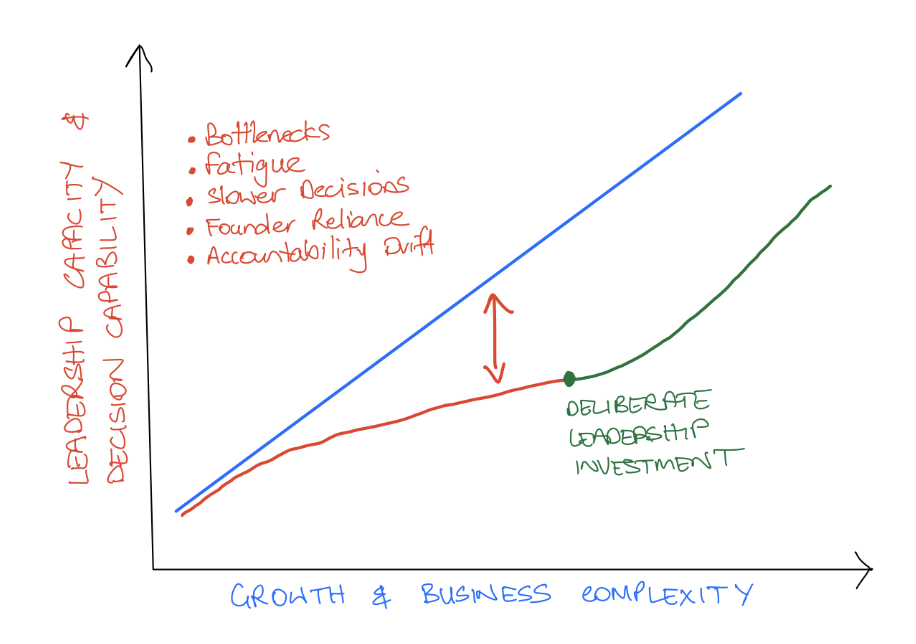
(Source: Deb Bailey Ltd – The Growth Pressure Curve)
Complexity scales naturally. Leadership capability does not.
As firms scale, pressure, change, and operational demands often rise faster than leadership capability evolves. Over time, this creates a widening gap between what the business requires and what the leadership system can consistently sustain.
Without deliberate investment in leadership development, decision quality slows, accountability weakens, and founders or senior leaders continue carrying increasing levels of operational pressure.
Strong firms recognise this early and build leadership capacity intentionally as the business grows.
The Capacity Trap in Growing Firms
Growth, pressure, and change all increase the demands placed on leadership teams.
What worked at $20 million often does not work at $80 million. The informal communication, fast decision making, and hands on oversight that helped a business grow in its early stages can eventually become the very things that slow it down.
This is where many firms become trapped.
The business keeps expanding, but the leadership system does not deepen at the same rate. As complexity increases, leaders become more reactive, founders hold tighter control, and senior teams spend more time managing operational noise than thinking strategically. Over time, this creates fragility.
And in construction, fragility tends to show up quickly through margin pressure, inconsistent delivery, leadership fatigue, and reputational risk. Not to mention it’s just exhausting.
Leadership maturity is not automatic. It must be developed intentionally and deliberately, just like any other strategic investment within the business.
Because sustainable growth requires more than technical delivery, more than just working harder and more than just being more focused.
It requires leaders at every level who can think clearly under pressure, hold standards consistently, communicate effectively, and align around shared direction.
Leadership Depth Must Be Built Deliberately
Strong firms do not simply grow projects. They grow leadership capability alongside the business. This is what increases bench strength over time and creates leaders for the future. It’s the succession plan.
Strong businesses create clearer decision making structures. They invest in leadership maturity before pressure exposes the gaps. They strengthen alignment across senior teams and ensure accountability evolves as the business evolves.
Most importantly, they recognise that leadership development is not a “nice to have” activity disconnected from commercial outcomes. It is directly tied to performance.
Because businesses do not scale sustainably through effort alone. They scale through leadership systems that can hold increasing complexity without losing clarity, standards, or direction.
If your firm is currently scaling, changing, or operating under sustained pressure, it may be worth asking:
Where is leadership capability keeping pace?
Where is it beginning to lag?
What pressure is really operational, and what pressure is actually capacity?
What would change if leadership development was treated as a commercial investment rather than a secondary priority?
A Final Thought
Growth, change, and pressure all increase complexity.
They do not automatically increase leadership depth.
If pressure feels heavier as revenue rises, the issue may not be scale itself. It may be the leadership system beneath it.
Strong firms develop leaders and teams deliberately because sustainable performance requires more than opportunity alone.
It requires maturity at every level.
Need Some Help?

If these themes are raising useful questions for you or your senior team, that is often where the real work begins.
Because sustainable performance is rarely just operational. More often, it reflects how leadership capability, alignment, decision quality, and accountability are functioning beneath the surface as complexity increases.
If you would like to explore these ideas further, I have recently written a Whitepaper exploring the leadership and performance patterns emerging across construction and infrastructure businesses, and why leadership systems play such a critical role in sustainable performance.
You can download a copy of that here, Blueprint for Sustained Performance: Why Leadership Systems Shape Performance in Construction Organisations.
Whether through executive coaching, senior team facilitation, or diagnostic led insight, the goal is the same:
To build leadership capability that can sustain performance as complexity grows.
Because growth alone is not the measure. Sustainable performance is.
See you in two weeks with the next instalment of Blueprint for Sustained Performance.
If at any point you’d value a commercially grounded conversation about alignment, governance clarity, or leadership discipline in your firm, you’re welcome to contact me directly.