
Source: Deb Bailey Ltd
Blueprint for Sustained Performance
Issue 9: Why Good People Stay and Leave
Blueprint Lens: Culture and Performance Standards. Retention is not primarily a recruitment challenge. It is a leadership and culture outcome. The consistency of your standards, expectations, and leadership behaviours determines whether talented people build a career with you or look elsewhere.
When behavioural standards shift under pressure, your top performers notice
In the last issue, we looked at how leaders model culture through their responses in difficult moments.
Retention is a challenge that most construction firms have on their radar. It is something I hear about regularly and is often the downstream effect of their leadership responses.
Construction leaders often say the same thing: "Good people are hard to find." That is certainly true. What is equally true is that good people are hard to keep, which means retention deserves just as much attention as recruitment.
The Cost of Losing Good People
When skilled team leaders, project managers, quantity surveyors, senior leaders, or other key contributors leave, the impact is immediate. Why? Because:
Productivity slows. We have just lost someone who was carrying a significant workload and contributing valuable expertise.
Knowledge walks out the door, and this often costs more than we realise. Especially that institutional knowledge of how your business does things.
Morale dips. Don't underestimate the impact on those left behind, particularly if several people leave within a relatively short period. This makes people feel uneasy and they often wonder if the grass is greener on the other side.
Clients feel instability. The departing employee may have been their primary point of contact. It is always worth remembering that people like doing business with people they know and trust. When that person leaves, it can create uncertainty.
Replacing a senior project manager, for example, is expensive in itself. Replacing their knowledge is even more costly and often takes considerably longer.
It is not just knowledge of how to do the job. It is knowledge of your systems and processes, your clients, the way relationships work both inside and outside the organisation, and the countless nuances that help people perform effectively. The list really does go on.
Retention is often discussed as a market issue, and of course the market has an influence on the talent available. In many cases, however, retention is a leadership issue.
Why Retention is a Leadership Issue
The outcomes leaders experience are often downstream of the behaviours, standards, and conditions they create upstream.
People watch leadership behaviour far more closely than leaders realise. When standards change depending on pressure, personalities, or circumstances, trust starts to erode. Once trust starts to erode, retention often follows.
The Stay Decision
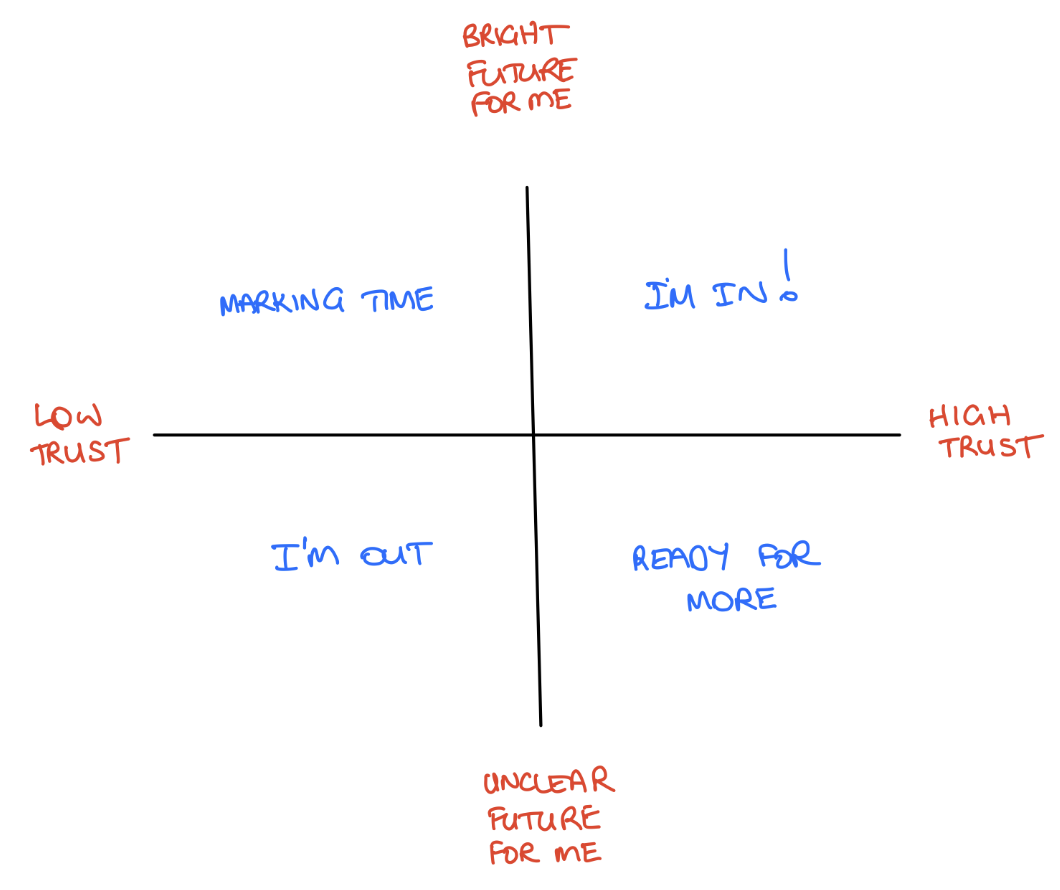
Most talented people are constantly assessing two things:
Do I trust the leadership around me? and
Can I see a future for myself here?
Their answers to those questions often determine whether they stay, grow, disengage, or leave.
Source: Deb Bailey Ltd: The Stay Decision
The goal is not to keep every employee forever. Some people will eventually outgrow the opportunities available. The real risk sits in the left-hand side of the model, where trust has been compromised and retention becomes increasingly difficult.
Why People Stay
People tend to stay where standards are clear, expectations are consistent, and conversations happen when they need to happen.
Most people are not looking for perfection. They are looking for certainty. They want to know what good performance looks like, how decisions are made, and whether the standards apply equally to everyone.
They also want to know that growth is possible, is there a bright future for me here?
That does not necessarily mean promotion. Sometimes growth means new challenges, greater responsibility, learning opportunities, or simply knowing that someone is paying attention to their development and future aspirations.
When people experience clarity, fairness, and genuine investment in their success, they are far more likely to stay and contribute over the long term.
Why People Leave
The opposite is also true.
People don’t often leave because of a single bad day or difficult project. More often, they leave after experiencing the same frustrations repeatedly.
They leave when accountability is inconsistent and some people appear to be held to different standards than others. They leave when conflict is avoided and problems linger unresolved. They leave when senior leaders send mixed messages, making it difficult to understand priorities or know which direction to follow.
For high performers in particular, one of the biggest frustrations is feeling as though their development has stalled. When people development becomes an afterthought, talented people naturally start looking elsewhere for opportunities to grow.
Over time, these experiences create uncertainty and disengagement. Once that happens, it is often only a matter of time before people begin considering their next move.
Retention Requires Leadership Maturity
Retention is not about perks or special treatment for a select few. It is about leadership maturity at every level.
It is about understanding your people, their career aspirations, and how those aspirations fit within their broader goals for life.
There is little value in giving a high performer who is already struggling with work life balance another major project that demands even more of their time and energy. Eventually, they will reach a point where the workload becomes unsustainable, and they will either disengage, burn out, or leave.
Unfortunately, many of us have bought into the saying, "If you want something done, give it to a busy person." That is not a sustainable strategy, and eventually it will backfire.
Just because someone is highly organised, driven, reliable, and capable does not mean they have unlimited capacity. You cannot keep pouring water into a bucket and expect it to never overflow.
Becoming an Employer of Choice
If you want to become an employer of choice in your sector, the work starts at the top.
Retention needs to be a strategic priority, and that begins with the senior leadership team having absolute clarity about the strategy and what it requires of them in terms of how they show up, lead, and work together.
A top performer looking for their next opportunity will not join just any construction firm.
Assuming the hygiene factors are in place, such as fair remuneration and reasonable working conditions, they will typically choose the organisation where leadership has a strong reputation, expectations are clear, and deliberate attention is paid to their development and career aspirations.
A Final Thought
Retention is not always about workload alone.
More often, it is about clarity, confidence in leadership, and the quality of the environment people experience every day. Along with the feeling of adding value, belonging and growing.
If turnover concerns you, start by looking at the alignment of your leadership team and the attention being given to people development across the organisation.
Leadership instability and misalignment are among the quietest drains on performance and culture because uncertainty is incredibly unsettling for people.
Need Some Help?

If these themes are raising useful questions for you or your senior team, that is exactly the point.
Sustainable performance is not just operational. More often, it reflects how leadership capability, alignment, decision quality, and accountability are functioning beneath the surface as complexity in the business increases.
If you would like to explore these ideas further, I have recently written a Whitepaper exploring the leadership and performance patterns emerging across construction and infrastructure businesses, and why leadership systems play such a critical role in sustainable performance.
You can download a copy of that here, Blueprint for Sustained Performance: Why Leadership Systems Shape Performance in Construction Organisations.
If the themes in the Whitepaper resonate with you, the next step is to explore what they look like in your organisation. Through the Blueprint Leadership Discovery process, we identify the leadership, alignment, and performance factors most likely to be influencing your current results, creating a practical foundation for sustained performance.
This work can be explored at three levels:
One to one executive coaching for owners and senior leaders
Senior team facilitation focused on alignment, strategy, and performance
Diagnostic led insight to understand personality, leadership impact, and team dynamics
Because better results rarely start with working harder.
They start with leading more deliberately.
See you in two weeks with the next instalment of Blueprint for Sustained Performance.
If at any point you’d value a commercially grounded conversation about alignment, governance clarity, or leadership discipline in your firm, you’re welcome to contact me directly.