
Source: Deb Bailey Ltd
Blueprint for Sustained Performance
Issue 6: Personality and Commercial Risk
Blueprint Lens: Commercial risk is shaped as much by leadership bias under pressure as it is by external conditions.
Every construction firm has a risk profile.
It shows up in the projects you bid for, the margins you are willing to accept, the clients you choose to work with, and the speed at which you grow.
What is less visible is this.
That risk profile is heavily influenced by the personality of the Founder, CEO, and Leadership Team.

(Source: Image by Alexander Lesnitsky from Pixabay)
Leadership Bias
Most leaders believe their commercial decisions are rational. Data driven. Logical. And many are. But under pressure, personality amplifies.
Some leaders lean toward optimism. They see opportunity first and back growth. They are comfortable stretching.
Others lean toward caution. They focus on protecting margin and tighten costs quickly. They prefer steady scaling over ambitious growth.
Some leaders are highly decisive. They move fast and expect others to keep up, often not noticing when people are not on the same page.
Others prefer alignment. They test ideas broadly before committing and work collaboratively toward a decision.
None of these patterns are right or wrong.
But each one carries commercial implications and shows up not only in individual leadership behaviours but also in the collective dynamic of the senior team.
How It Combines
When these tendencies combine across a leadership team, they create a predictable pattern of commercial behaviour. These patterns will also be influencing and impacting on how you identify, develop and execute on strategy. They also influence and impact the type of culture you are creating in your business and the results you either are or aren’t achieving.
Most teams won’t sit at an extreme, but under pressure, patterns tighten and a dominant position often emerges.
When pressure builds, leadership patterns don’t disappear, they become more pronounced.
Leadership Bias Under Pressure
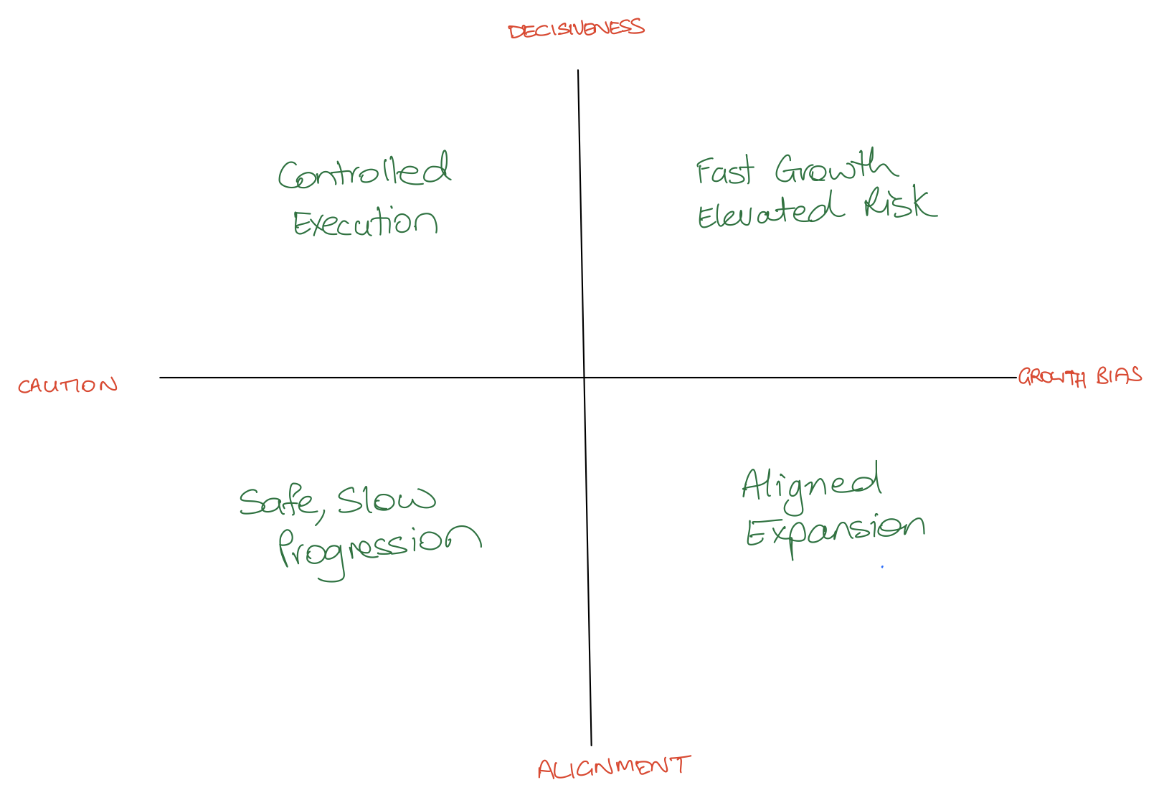
(Source: Deb Bailey Ltd – Leadership Bias Under Pressure Model. How leadership tendencies shape commercial decisions, risk appetite, and pace when it matters most)
What This Looks Like in Practice
Most teams will recognise themselves somewhere on this model. The question is whether that position is deliberate, or simply the result of default patterns under pressure.
Fast Growth, Elevated Risk
What it looks like: Momentum is high. Decisions are made quickly and the business is pushing forward.
Commercial risk: Risk is not always fully tested. Margin can be compromised to secure work.
Example: A CEO backs a major project at a tight margin to secure pipeline and maintain utilisation. The job is won quickly, but delivery pressure increases and margin is exposed early.
Controlled Execution
What it looks like: Clear, firm decisions with a strong focus on protecting margin and reducing exposure.
Commercial risk: Opportunities are often declined early. Growth can stall despite capability.
Example: A leadership team declines a complex project due to perceived risk, even though the capability exists internally. The opportunity is missed and competitors step in.
Aligned Expansion
What it looks like: Strong buy-in across the team, with energy and ambition behind decisions.
Commercial risk: Decisions take longer and risk may not be challenged deeply enough.
Example: A team builds alignment around a new opportunity. Everyone is on board, but key commercial risks are not rigorously tested, creating pressure later in delivery.
Safe, Slow Progression
What it looks like: Careful, considered decision making with broad input and strong risk awareness.
Commercial risk: Pace slows and windows of opportunity close.
Example: A business revisits the same investment decision multiple times. The thinking is sound, but the delay means the opportunity passes.
None of these positions are wrong.
The risk sits in staying in one by default, particularly when pressure is high.
Commercial Impact Under Pressure
An optimistic leader may underprice risk to secure growth.
A cautious leader may miss strategic expansion windows.
A highly decisive leader may override useful challenge.
An alignment-focused leader may slow critical action.
When markets are stable, these tendencies can balance out. When pressure and volatility rise, they intensify and this is where blind spots become expensive.
If we do not understand our behaviour patterns under pressure, we operate at the mercy of them, regardless of our intention. When the pressure is on, our cognitive capacity narrows. Our brain feels full. We default to what is familiar but what may not always be useful.
We have all had moments where we have said or done something under pressure and later thought, I wish I had handled that differently.

(Source: Image by Tumisu from Pixabay)
Interpreting Risk
Commercial risk is not only about contracts and clauses. It is about how you interpret information, especially when the pressure is on.
If your natural bias is to push forward, do you have strong voices around you who test downside risk?
If your bias is to protect, do you have people who stretch your thinking beyond safety?
If you avoid tension, do concerns remain unspoken in senior meetings?
Where It Shows Up
Personality shapes:
Pricing discipline
Project selection
Hiring decisions
Succession planning
Investment timing, etc
It also shapes how safe your senior team feels to challenge you and therefore, how safe other leaders or employees feel they can challenge the senior team. It becomes part of your company culture.
Leadership Maturity
Leadership maturity is not about changing your personality. It is about understanding it.
When leaders know their tendencies under pressure, they make more balanced decisions. They build complementary teams. They invite robust debate. They separate emotional reaction from commercial reality.
High performing teams take the time to measure and understand both individual and collective patterns, so they can see how these influence strategy, culture, and results.

(Source: Image by PIX1861 from Pixabay)
The Better Question
If you look at your current risk profile, ask yourself:
How much of it reflects the market?
And how much reflects me and the senior leadership team, particularly under pressure?
Performance is strengthened not just by analysing the numbers, but by understanding the lens through which you read them.
Personality can be measured, just like finance, rework and project performance.
A Final Thought
Your business carries a risk profile.
So do you as an individual leader and therefore, so does the collective personality profile of your senior team.
Optimism, caution, decisiveness, avoidance. These are not flaws. They are tendencies.
The question is whether those tendencies are being balanced, or amplified, under pressure.
Understanding your own bias is not self-indulgent, and it is definitely not remedial work. It is more like taking your car for a Warrant of Fitness to ensure it is roadworthy.
It is commercial protection.
Need Some Help?

If these themes are raising useful questions for you or your senior team, that is the point.
A practical place to start is understanding how leadership, team, and strategy interact to shape performance and culture over time.
If you would like a copy of my Whitepaper: Blueprint for Sustained Performance: Why Leadership Systems Shape Performance in Construction Organisations, just reply to this email and I will send one through.
For those already thinking more deeply about this, the work typically starts in one of three ways:
One-to-one executive coaching for owners and senior leaders
Senior team facilitation focused on alignment, strategy, and performance
Diagnostic-led insight to understand personality, leadership impact, and team dynamics
Because better results rarely start with working harder, they start with leading more deliberately.
Sustained performance begins with measured leadership.
See you in two weeks with the next instalment of Blueprint for Sustained Performance.
If at any point you’d value a commercially grounded conversation about alignment, governance clarity, or leadership discipline in your firm, you’re welcome to contact me directly.