
Source: Deb Bailey Ltd
Blueprint for Sustained Performance
Issue 5 - Why Strategy Breaks Down in Construction Firms
Blueprint Lens: Strategy is a leadership system test. What looks like a strategy problem is often a signal that alignment, behaviour, or decision-making under pressure is out of sync.
I often see well thought through strategies stall more often than they should. And it is rarely because the plan is flawed or the market has shifted in some dramatic, unexpected way.
More often, it is because the leadership capacity required to execute the strategy has been underestimated.
In construction, strategy frequently lives in a document. A process has been followed, and clear intent has been set. That intent usually includes:
Revenue targets
Market segments
Geographic expansion
Capability growth
All sensible. Often necessary.
Yet twelve months later, progress feels uneven. The pressure of balancing strategic initiatives with business as usual starts to show up, and the signals become familiar:
Execution is inconsistent
Priorities begin to drift
The senior team pulls in slightly different directions
When that happens, the instinct is to revisit the plan, as though the answer will reveal itself on the page. But often, the plan is not the problem.
In my experience, strategy tends to fail quietly in three places.
1. Alignment at the Top
The first place strategy breaks down is at the senior team level.
Leaders may agree in the room, but interpret differently in practice. Operations drives one priority. Commercial drives another. Finance protects margin. Each perspective is valid on its own, but collectively the organisation starts to feel stretched.
Under pressure, this becomes more pronounced. Senior leaders are pulled back into their functions, and what was intended as collective leadership becomes siloed execution.
Alignment is not what is said once. It is what is reinforced consistently.
2. Leadership Blind Spots
The second pressure point sits within the leaders themselves.
Every CEO and senior leader brings natural preferences. Some lean towards growth and opportunity. Others towards caution and protection. Some avoid conflict. Others push for pace.
These tendencies shape not only how strategy is set, but how it is interpreted and executed.
A growth orientation can underplay operational strain
A cautious approach can delay necessary expansion
Avoidance of conflict can allow misalignment to sit unresolved
Personality patterns do not stay contained. They scale through the business. And over time, they shape execution more than the strategy ever will.
3. Pressure and Reactivity
The third place strategy starts to erode is in how leaders respond under pressure.
As projects intensify or market conditions tighten, short term urgency begins to override long term direction. Strategy becomes something to return to when there is time.
The reality is, strategy only works when it guides daily decisions.
Execution is rarely an activity problem. There is usually no shortage of effort.
It is a leadership system problem.
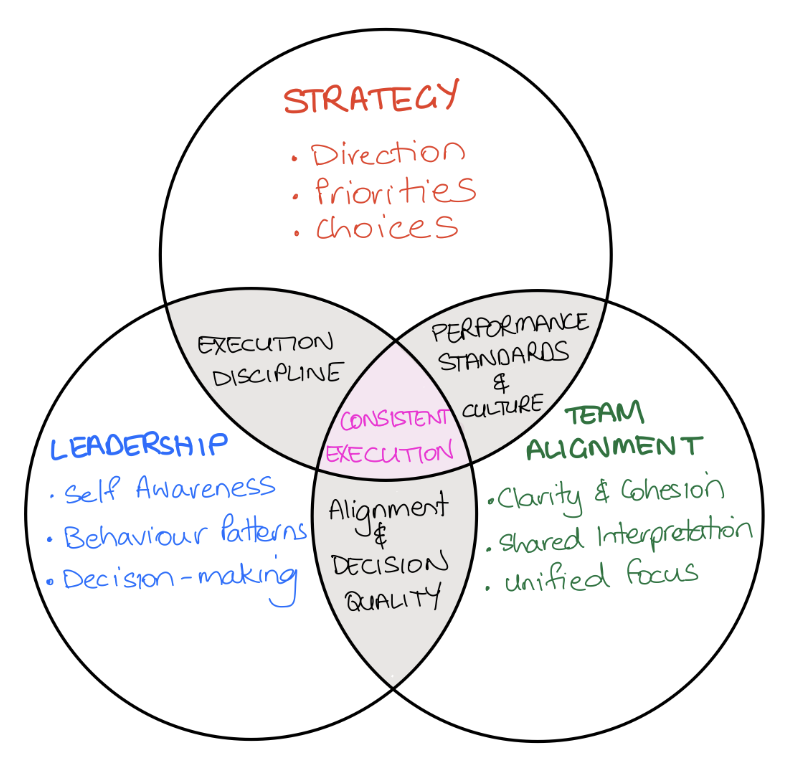
If we step back, what sits beneath strategy is a leadership system that determines whether it is executed consistently or not.
The Leadership System Beneath Strategy Execution
Source: Deb Bailey - The Leadership System Beneath Strategy Execution
When one part of this system is stronger than the others, execution becomes uneven. Strategy may be clear, but alignment is inconsistent. Alignment may exist, but leadership behaviour under pressure disrupts it.
Often, the system that supports the business has not kept pace with the demands being placed on it.
The Leadershp System Beneath Strategy
A scalable leadership system requires:
Clarity at the top
Consistent messaging across the business
Aligned standards of performance
A willingness to challenge drift early and directly
It also requires leaders to understand their own impact.
Self-awareness is often positioned as something remedial. Something to address when there is a problem.
In reality, it is a performance lever.
If we think about high performance environments, we measure what matters. We refine constantly. We adjust based on insight.
Leadership is no different.
Just as a high performance yacht or car is continually tuned to maximise speed, efficiency and impact, leadership requires ongoing adjustment. Not because something is broken, but because better performance is always available when we understand what is driving our decisions, behaviours, and patterns under pressure.
Most construction businesses do not struggle with urgency. They struggle with maintaining clarity while operating within it.
A Question Worth Considering
If your senior team feels fragmented, if progress is slower than expected, or if initiatives stall midway, consider this:
Is the strategy unclear?
Or is leadership capacity stretched?
More specifically:
Where might your own preferences be strengthening execution?
And where might they be quietly weakening it?
Because strategy does not outperform the leader carrying it.
A Final Thought
When execution stalls, it is tempting to revisit the plan.
Often, the plan is not the issue.
Strategy reflects leadership capacity. And leadership capacity determines whether targets are achieved or remain aspirational.
If alignment is uneven, if standards drift, and if priorities shift under pressure, strategy weakens quietly.
Before rewriting direction, examine discipline.
Because strategy succeeds when leadership maturity sustains it.
Need Some Help?

If these themes are raising useful questions for you or your senior team, that is the point.
This work can be explored at three levels:
One-to-one executive coaching for owners and senior leaders
Senior team facilitation focused on alignment, strategy, and performance
Diagnostic-led insight to understand personality, leadership impact, and team dynamics
Because better results rarely start with working harder, they start with leading more deliberately.
Sustained performance begins with measured leadership.
See you in two weeks with the next instalment of Blueprint for Sustained Performance.
If at any point you’d value a commercially grounded conversation about alignment, governance clarity, or leadership discipline in your firm, you’re welcome to contact me directly.