
Blueprint for Sustained Performance Issue 4 - When Urgency Becomes the Culture
Source: Deb Bailey Ltd
Blueprint for Sustained Performance
Issue 4 - When Urgency Becomes the Culture
Blueprint Lens: Urgency is not the issue. The system leaders create to manage it determines whether performance strengthens or fragments.
In construction, time is one of the few resources we are constantly aware of. Programmes are moving, variations are landing, clients are pushing, and cashflow is always in play. Urgency is part of the industry and, if we are honest, it is one of the things we both enjoy and feel the pressure of.
The issue is not urgency itself, it is that we are often operating inside it constantly.
When everything feels urgent, leaders can quickly shift into reactive mode. Decisions become faster, but not necessarily better. Conversations shorten, challenge reduces, and thinking begins to narrow. Activity increases, but clarity often decreases.
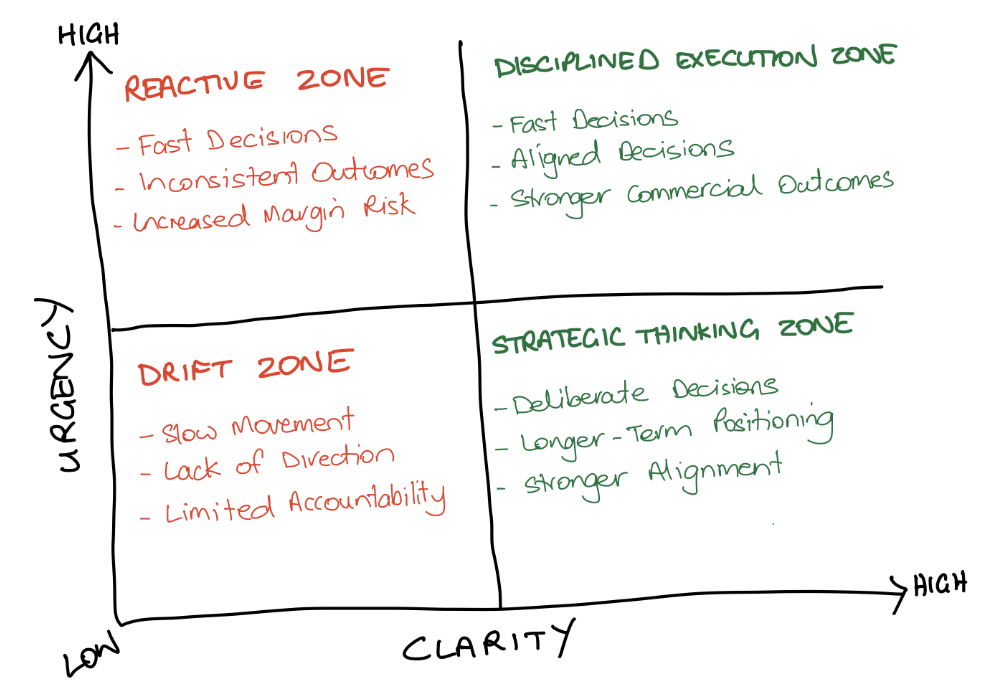
One way to think about this is the environment your decisions are being made in.
Decision Environment Under Pressure
Source: Deb Bailey - Decision Environment Under Pressure
Where Tension Sits
Most construction businesses do not struggle with urgency. They struggle with maintaining clarity while operating within it.
When Urgency Starts to Shape Culture
Over time, when urgency becomes constant, it starts to shape culture.
Senior teams can begin to operate in parallel rather than together. Siloed ways of working quietly return. Important conversations are postponed because there is “no time”, and strategy becomes something to revisit later, when things settle down.
The difficulty is that things rarely settle. That is the nature of the environment.
What Starts to Slip
When urgency becomes the default operating rhythm, a few patterns tend to show up over time.
Productivity often drops even as effort increases. People are busy, but not always aligned, and not always focused on what matters most. Margin discipline begins to weaken. Rushed decisions rarely prove to be the most commercial ones in the long run.
Leadership depth can stall. There is little space to coach, develop, or think beyond the next immediate issue.
What Strong Leaders Do Differently
This is not about slowing down the business. It is about slowing down the thinking.
Strong leaders do not remove urgency from the system, but they do regulate it. They are deliberate about where pace is required and where clarity must be protected.
They distinguish between what is genuinely critical and what is simply noisy. They create space for senior teams to think together, not just report. Thinking allows a team to look forward, while reporting tends to keep attention anchored in what has already happened.
They also hold standards, even when time is tight. That can feel like the harder path in the moment, but it is often the steadier approach that creates consistency across the business.
Your internal pace sets the pace of the business, whether you are conscious of it or not.
If you are constantly operating at full tilt, your team will too. And when everyone is operating at that level, judgement begins to suffer. This is how culture is formed in real time. It does not wait for a quieter period to emerge.
A Useful Pause Point
Consider this.
Where in your business is urgency real, and where has it become habitual?
And more personally, when pressure increases, do you accelerate, tighten control, or withdraw?
The answers to those questions will tell you a great deal about your current performance ceiling, and what you default to as a leader under pressure.
A Final Thought
Urgency can feel productive, but constant urgency rarely is.
When everything is critical, nothing is prioritised well. Decision quality drops, alignment weakens, and standards begin to blur. Over time, that creates confusion across the business.
We all have the same 24 hours in a day, but how those hours are led, prioritised, and experienced varies significantly across businesses. That is what ultimately shapes performance.
If your team feels permanently stretched, it is worth considering whether urgency has become habitual rather than necessary.
Need Some Help?

If these themes are raising useful questions for you or your senior team, that is the point.
This work can be explored at three levels:
One-to-one executive coaching for owners and senior leaders
Senior team facilitation focused on alignment, strategy, and performance
Diagnostic-led insight to understand personality, leadership impact, and team dynamics
Because better results rarely start with working harder, they start with leading more deliberately.
Sustained performance begins with measured leadership.
See you in two weeks with the next instalment of Blueprint for Sustained Performance.
If at any point you’d value a commercially grounded conversation about alignment, governance clarity, or leadership discipline in your firm, you’re welcome to contact me directly.