
Source: Deb Bailey Ltd
Blueprint for Sustained Performance
Issue 3 - When Fear Quietly Shapes Decisions
Blueprint Lens: Under pressure, leaders rarely talk about fear, but it quietly shapes judgement, narrowing thinking and influencing the commercial decisions that ultimately determine performance.
Construction leaders do not often talk about fear. They talk about pipeline, cash flow, work in hand, risk, and headcount, to name but a few.
But underneath all of those sits something quieter. Uncertainty about what comes next.
And uncertainty changes how leaders decide.
When markets tighten, or margins compress, fear does not usually show up as panic. It shows up as subtle shifts in behaviour:
Holding onto underperforming people because replacing them feels risky
Discounting more aggressively than necessary to secure work
Delaying strategic hires
Avoiding tough conversations at the senior level
Micromanaging where trust used to sit
None of these decisions looks dramatic in isolation, but over time, they compound.
Fear narrows thinking, and it shortens time horizons. It reduces the challenge in the room, and what we notice if we can step back from the current situation, is that decision quality drops before results do.
The problem is not that fear exists after all, in construction, risk is real. The problem is when fear becomes invisible.
Every leader has a default pattern under pressure. And for most of us, those patterns run on autopilot, and we are not consciously aware of them. We often refer to this as our 'blind spots'. What this could look like in real time is:
Some leaders become more controlling
Some become overly cautious
Some become optimistic to the point of minimising risk
Some avoid conflict and hope things settle
Your personality does not disappear when volatility rises; it becomes amplified. And those patterns influence some of the most commercial decisions a leader makes.
Also, when we default to these behaviour patterns under pressure, it's because our brain does not have the cognitive capacity to make a different, possibly better choice - hence the term autopilot.
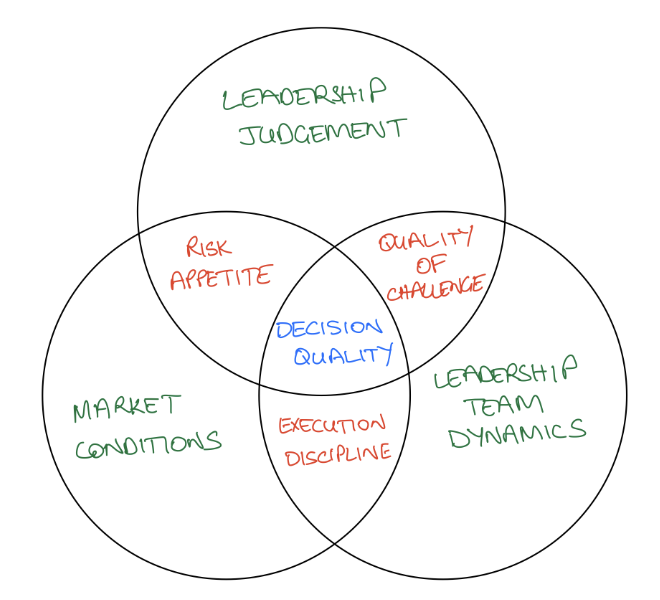
(Source: Deb Bailey - The interaction between leadership judgement, team dynamics, and market conditions shapes decision quality.)
And that amplification shapes:
Pricing discipline
Hiring decisions
Project selection
Succession planning
Investment in capability
This is where leadership maturity matters.
Strong leaders do not eliminate or ignore fear; they recognise it early and widen their thinking instead of narrowing it.
They invite robust challenge from their senior team, and they separate real commercial risk from emotional reaction.
If you are leading in a tighter market right now, consider this:
Where might fear be quietly influencing your decisions?
Are you tightening standards, or lowering them to feel safe?
Are you slowing necessary change, or rushing activity to reduce discomfort?
And what would change if you named the fear in the room rather than letting it operate in the background?
Because performance is not just about the decisions you make, it is about the condition you are in when you make them.
A Final Thought
Fear is not the problem. Unexamined fear is.
Every leader carries a natural behaviour pattern under pressure. When that pattern operates unconsciously, decision quality quietly erodes.
If you notice hesitation, overcontrol, or urgency creeping into your leadership, that is useful information and something to pay attention to.
Profit is rarely damaged by one decision. It is eroded by small, fear-based choices repeated over time.
Leadership maturity begins with recognising that pattern early. Because the way a leader responds to pressure quickly becomes the team’s operating pattern.
Need Some Help?

If these themes are raising useful questions for you or your senior team, that is the point.
This work can be explored at three levels:
One-to-one executive coaching for owners and senior leaders
Senior team facilitation focused on alignment, strategy, and performance
Diagnostic-led insight to understand personality, leadership impact, and team dynamics
Because better results rarely start with working harder, they start with leading more deliberately.
Sustained performance begins with measured leadership.
See you in two weeks with the next instalment of Blueprint for Sustained Performance.
If at any point you’d value a commercially grounded conversation about alignment, governance clarity, or leadership discipline in your firm, you’re welcome to contact me directly.