
Source: Deb Bailey Ltd
Blueprint for Sustained Performance
Issue 2 - Clarity When The Market Feels Unstable
Blueprint Lens: In volatile markets, leadership behaviour shapes decision quality long before financial results show the impact.
Volatility does not just affect forecasts. It also affects how we think.
In construction, uncertainty is normal. But prolonged uncertainty shifts behaviour in subtle ways.
Depending on how a leader plays their inner game of leadership, pressure over time can begin to show up in three common patterns:
Decisions are delayed while waiting for more data. Caution increases, and momentum slows.
Decisions are rushed in an attempt to regain a sense of control. Impulsiveness replaces considered judgement.
Leaders focus heavily on short-term cost and lose sight of long-term positioning.
All three reduce clarity at the very moment it is needed most.
The real risk is not simply making the wrong call. The greater risk is that our field of thinking narrows.
When leaders operate in a constant reactive state, which is what most of us do when we are under pressure, three things tend to happen:
Senior teams challenge less robustly because they do not want to slow momentum.
Strategy turns into urgent activity, and the important work quietly slips away.
Margin discipline weakens through fatigue, overwhelm, and frustration. All of which are expensive.
Clarity is not about optimism. It is about steadiness when the environment around you feels chaotic.
Steadiness allows leaders to separate signal from noise and to hold a longer view when others are contracting their thinking. It protects standards when work begins to feel scarce.
This is where personality matters, and it is also why measurement matters.
Under pressure, leaders rarely see their own patterns clearly. The very behaviour that helped them succeed earlier in their career can quietly become a constraint when volatility increases.
Without measurement and reflection, most leaders assume the market is the problem when, in reality, their decision patterns may have shifted.
Why Personality Matters
Understanding how we play our 'inner game' of leadership matters because it directly shapes the 'outer game' results we produce.
Under pressure, different patterns tend to emerge:
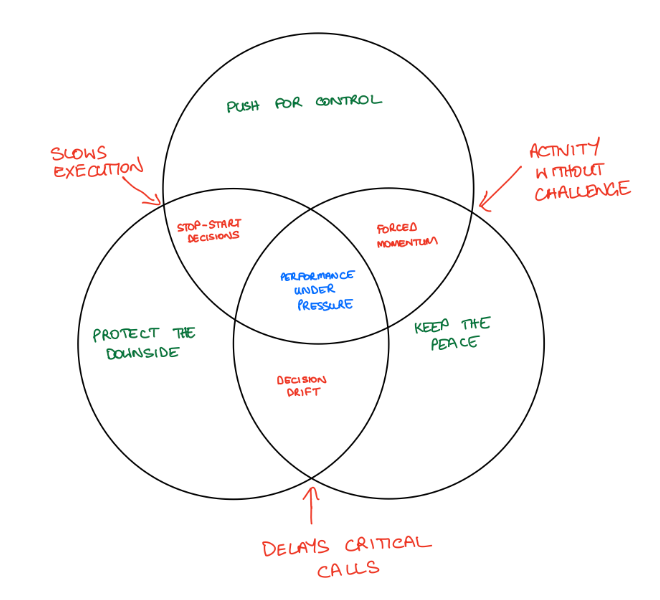
(Source: Deb Bailey Ltd - The Performance Under Pressure Model - How leadership responses shape decision quality when pressure rises)
Some leaders become more dominant and demonstrative. Their need to drive action and push for control increases.
Some become more cautious and quieter than usual. At times, they can appear distant or slightly removed from the conversation. They are often protecting the downside.
Some avoid conflict altogether and find it easier to stay agreeable than to voice their concern. They become more focused on keeping the peace.
Each of these patterns influences commercial decisions. Pricing. Hiring. Negotiation. Risk appetite.
Self-awareness is not soft or abstract when it is gained through robust measurement. It is commercial protection.
If your market feels unstable right now, consider this: Are you reacting to the volatility, or leading through it?
And perhaps more importantly: What is your senior team experiencing from you?
Because clarity at the top creates stability everywhere else.
A Final Thought
Uncertainty narrows thinking before it narrows margin.
When markets shift, the instinct is often to react faster. To tighten control. To search for certainty where there may not be any. But clarity is not created through speed. It is created through steadiness and awareness.
If your decisions feel rushed or overly cautious right now, pause for a moment.
Are you responding to facts, or reacting to volatility because you are operating on autopilot under pressure?
In unstable conditions, the clearest leader usually protects performance long before the numbers demand it. Because by the time margin shows the problem, the leadership patterns that created it have usually been in play for months, and we have been unconscious about what those behaviour patterns are and what we can do about them.Need Some Help?
Need Some Help?

If these themes are raising useful questions for you or your senior team, that is the point.
This work can be explored at three levels:
One-to-one executive coaching for owners and senior leaders
Senior team facilitation focused on alignment, strategy, and performance
Diagnostic-led insight to understand personality, leadership impact, and team dynamics
Because better results rarely start with working harder, they start with leading more deliberately.
Sustained performance begins with measured leadership.
See you in two weeks with the next instalment of Blueprint for Sustained Performance.
If at any point you’d value a commercially grounded conversation about alignment, governance clarity, or leadership discipline in your firm, you’re welcome to contact me directly.