
Source: Deb Bailey Ltd
Blueprint for Sustained Performance
Issue 17: Leadership Discipline Protects Margin
Blueprint Lens: Margin is often treated as a financial outcome. I see it differently. It is shaped long before the financial reports are produced through the leadership decisions that influence standards, accountability and execution across the business.
Looking Beyond the Numbers
When margins tighten, the first conversations often focus on reducing costs.
Projects are reviewed, budgets come under greater scrutiny, hiring decisions are delayed and it seems every expense is questioned.
Those are sensible conversations to have but they don't always address where margin first begins to slip.
In my experience, margin is shaped by hundreds of small leadership decisions made every day. Those decisions influence the standards people work to, the conversations leaders choose to have and the behaviours they consistently reinforce.
That's why I believe protecting margin starts long before the monthly financial reports arrive. It starts with leadership discipline.
The Habit of Checking the Bubble
Walk onto almost any construction site and you'll find a spirit level. Before a builder marks a line or fixes a frame, their eyes instinctively check one thing. The bubble. If it's centred, they keep going. If it has drifted, they make the adjustment before taking the next measurement.
It only takes a few seconds, but those few seconds prevent much bigger problems later.
Leadership discipline works in much the same way.
Pressure has a way of pulling our attention towards the urgent. Decisions come faster. Time becomes tighter. The temptation is to keep moving without stopping to check whether our decisions are still aligned with the standards we've set for the business.
At first, the compromises seem insignificant.
One project accepted that doesn't quite fit
One difficult conversation postponed
One performance issue left a little longer
One tender submitted on thinner margins
Each decision can be explained on its own but collectively, they begin to move the bubble. Maybe not enough to notice immediately but enough to influence the next decision, and the one after that.
Pressure Reveals Our Leadership
One of the assumptions I often hear is that pressure changes people but I don't believe it does.
Pressure simply exposes the leadership tendencies we naturally default to because they are the strongest patterns of behaviour we have under the circumstances.
Some leaders become more optimistic and convince themselves the next project will make up the difference and some become more cautious and begin cutting investment that the business still needs. Then some tighten control because it feels safer whilst others avoid difficult conversations because everyone already has enough on their plate.
None of those responses are inherently right or wrong. The question is whether they are helping protect the long-term health of the business, because every leadership response influences the decisions that follow.
Why Leadership Discipline Matters
This isn't just my observation.
Recent research from *Gallup found that creating accountability is the lowest-rated leadership competency, despite accountability being one of the strongest drivers of individual and organisational performance. Gallup's research also highlights that clear expectations, consistent standards and regular coaching are fundamental to creating high-performing teams.
It's a timely reminder that leadership isn't just about setting direction. It's about consistently reinforcing the standards and expectations that shape performance.
When standards become inconsistent, accountability becomes inconsistent. When accountability becomes inconsistent, so do the decisions people make every day and over time, those decisions begin to influence commercial performance.
Leadership discipline isn't about being tougher, it's about creating the consistency that allows people to perform at their best.
Leadership Discipline Is Built One Decision at a Time
When people hear the word discipline, they often think about working harder but that isn't what I mean.
Leadership discipline is the ability to consistently make decisions that reinforce the standards you've chosen for your business, even when pressure encourages you to do otherwise. Like holding firm on project selection, questioning optimistic assumptions before committing to a tender. Perhaps it’s addressing underperformance early instead of waiting, hoping it will resolve itself. Then there’s protecting quality when deadlines become tight and making decisions that strengthen the business six months from now, not just this week.
Every one of those decisions reinforces a standard and those standards influence the way people work. And, over time, they influence commercial performance.
Leadership Discipline
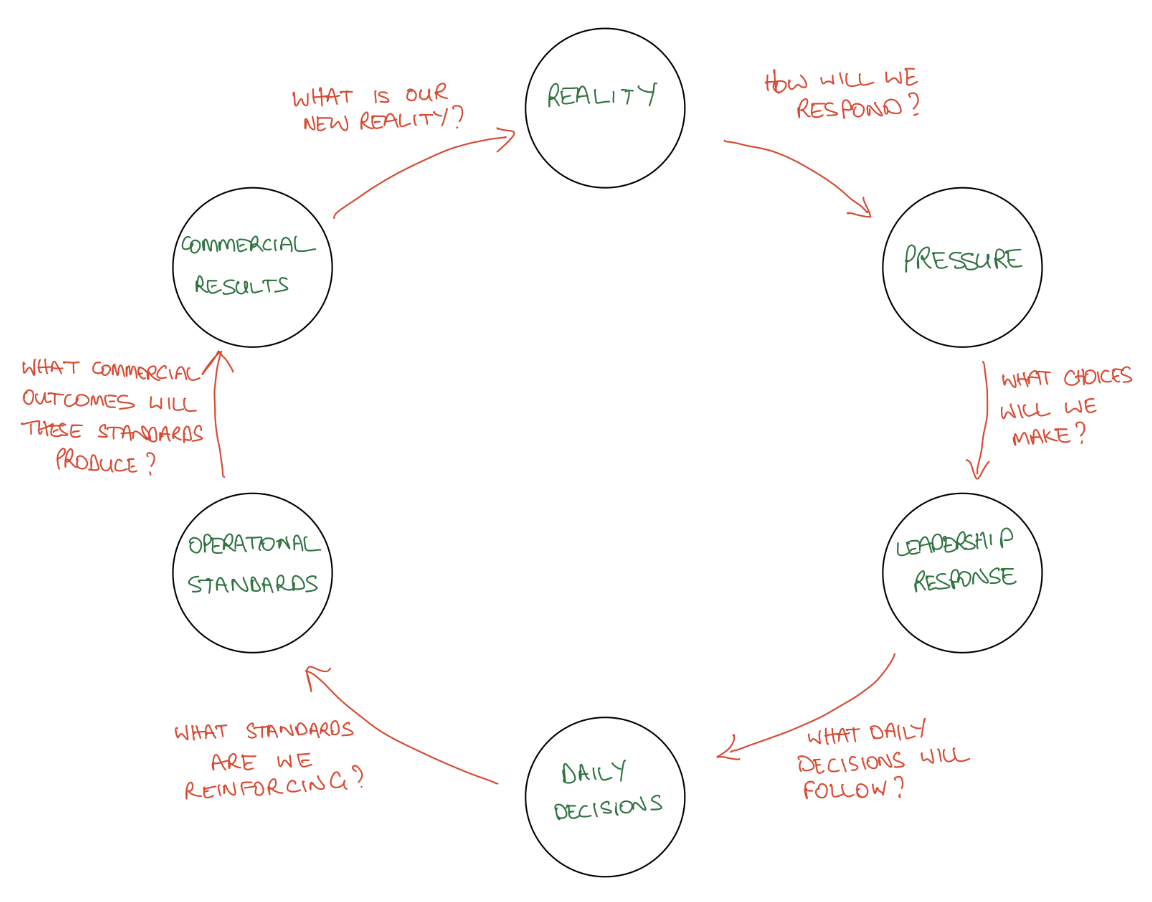
Leadership discipline isn't a single decision, it's a continuous cycle. Each set of commercial results creates the next leadership reality. The question is whether that reality strengthens leadership discipline or gradually allows standards to drift.
The Blueprint Leadership Discipline Cycle
(Source: Deb Bailey Ltd: The Blueprint Leadership Discipline Cycle)
The cycle never stops. Every commercial result becomes tomorrow's leadership reality.
Leadership discipline isn't about making one good decision. It's about creating a cycle where each decision reinforces the standards that produce better commercial outcomes.
Questions Worth Asking
As you reflect on your own business, consider these questions:
Where is the greatest pressure in the business right now?
Which leadership decisions are being tested most often?
What small compromises have gradually become accepted practice?
What standards are your leaders reinforcing through their daily decisions?
If nothing changes, what commercial results are those standards likely to produce over the next twelve months?
A Final Thought
A builder doesn't wait until the end of a project to discover something is out of alignment, they keep checking the bubble.
Leadership discipline requires the same habit.
The businesses that consistently protect their margins aren't making perfect decisions every day. They are continually checking that their decisions remain aligned with the standards they've chosen to lead by.
If you've been following the Blueprint for Sustained Performance series, you'll recognise how these ideas build on one another. We started by exploring Leadership Drift, where standards gradually move without anyone noticing. We then looked at The Leadership System, the structures that help leadership teams stay aligned. In the last issue, Planning for Results, Not Activity, we explored the importance of making deliberate choices about where leaders focus their attention.
This issue brings those ideas together, because even with the right leadership system and the right priorities, sustained performance ultimately depends on the discipline to consistently reinforce the standards that matter most.
Pressure will always test those standards. The question is whether it also changes them.
Every leadership decision either keeps the bubble centred or allows it to drift a little further.
Margin is not simply a financial measure, it is one of the clearest reflections of leadership discipline.
Need Some Help?

If this article has prompted you to reflect on how leadership is influencing commercial performance in your business, that's exactly the conversation worth having.
Sometimes the priority is helping a senior leadership team align around the standards and behaviours that matter most. Sometimes it's understanding the senior leadership team tendencies that are influencing important decisions. And sometimes it's simply having an experienced sounding board to help you think through the challenges you're facing.
Wherever you're starting from, the goal is the same: strengthening leadership so commercial performance becomes more predictable.
Further Reading
*Gallup. Accountability Is Leadership's Greatest Weakness – explores why creating accountability is one of leadership's biggest challenges and why clear expectations and consistent standards are so important.
See you in two weeks with the next instalment of Blueprint for Sustained Performance.