
Blueprint for Sustained Performance Issue 11: When SLT’s Drift into Silos
Source: Deb Bailey Ltd
Blueprint for Sustained Performance
Issue 11: When SLT’s Drift into Silos
Blueprint Lens: Leadership alignment is one of the foundations of sustained performance. When senior teams become less aligned, execution slows, standards become inconsistent and commercial performance begins to suffer. Alignment is not something leaders achieve once. It is something they continually need to protect.
In previous issues we have explored leadership capacity, role modelling and retaining great people. The next layer is how senior leaders operate together.
Many construction businesses have highly capable people sitting around the senior leadership table. Experienced operations leaders, commercially astute finance leaders, capable project directors and specialists who know their craft. Individually they are strong. Under pressure, however, they can gradually become less aligned as a leadership team.
Pressure Pulls Leaders Back into Their Functions
You may have worked hard to break down silos, only to discover that a particularly busy period quietly pulls everyone back into them. It doesn't happen because people stop caring. It happens because pressure naturally draws leaders back towards the functions they know best.
I often refer to this as leadership drift. Leadership drift is the gradual movement away from the behaviours, disciplines and ways of working that previously made the leadership team effective.
It isn't something leaders decide to do. It happens gradually as the business grows, pressure increases and people naturally spend more time focused on their own part of the business.
Leadership drift isn't about leaders deliberately doing something wrong. Sometimes it is simply a sign that the business has grown, become more complex or is facing different challenges. In those situations, leaders have an opportunity to step back and ask whether they simply need to realign around the disciplines that have drifted, or whether the business now needs a different leadership response.
If you've ever been sailing, you'll know a yacht can gradually drift off course without anyone noticing straight away. The wind changes slightly. The tide moves. Attention shifts to something happening on deck. None of those things seem significant on their own, but before long you're no longer heading where you intended.
Leadership drift works much the same way. At first, you probably don't notice it happening. Then one day you realise decisions are taking longer, messages are becoming inconsistent or people are pulling in slightly different directions. None of those things happened overnight. They built up over time.
Just as a skipper regularly checks the heading of the yacht and makes small adjustments to stay on course, leadership teams also need to check their heading. Leadership drift isn't something you either have or don't have. It sits on a continuum. Under pressure, leadership teams can gradually move towards operating in silos. The earlier that drift is recognised, the easier it is to realign around the behaviours and disciplines that will best serve the business today.
The Leadership Drift Continuum
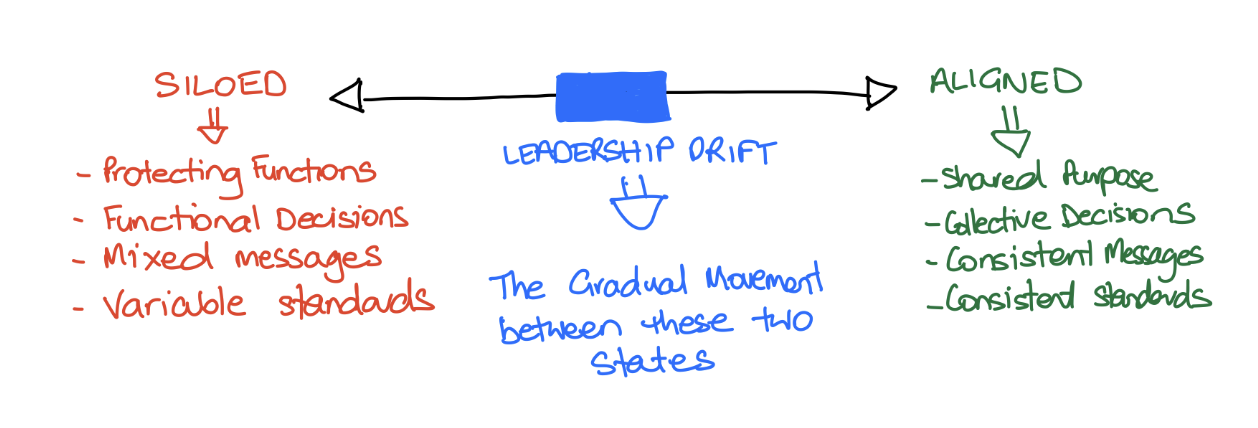
(Source: Deb Bailey Ltd: The Leadership Drift Continuum)
Operations are focused on maintaining delivery because deadlines matter. Finance is urging caution as costs and cash flow come under pressure. The commercial team is looking for opportunities to secure more work and maintain pipeline. Meanwhile, your people leaders are reminding everyone that fatigue is building and the current pace is becoming increasingly difficult to sustain.
Every function is acting rationally from its own perspective. The challenge begins when those perspectives are no longer connected by a shared view of what is best for the business as a whole.
Meetings become updates from each function rather than conversations about the business. Decisions become harder to reach. Debate becomes more defensive than constructive, and strategy gradually fragments into departmental priorities.
This is where the cost of leadership drift starts to show. Not because of one decision, but because a series of small shifts has gradually moved the senior team away from the way they intended to work together.
What Misalignment Looks Like
When senior leaders are no longer fully aligned, the signs often emerge gradually.
Standards begin to vary across projects. Some teams consistently deliver while others struggle, leaving leaders wondering why the same organisation produces such different outcomes.
Messages to the organisation become inconsistent. Different teams hear different interpretations of priorities and begin operating from their own version of what matters most.
Decisions are revisited weeks after they were supposedly made. At first it is easy to dismiss, until someone eventually asks, "Didn't we already decide this?"
Time is lost because the senior team is no longer operating from the same playbook. Shared goals become less visible, standards become less consistent and ways of working begin to diverge as the business grows.
Misalignment is expensive because it quietly slows execution, weakens accountability across the business and gradually erodes commercial performance. Many organisations don’t notice it immediately, but they almost always experience its impact.
What Aligned Senior Teams Do Differently
Strong senior teams are not aligned because they agree on everything. They are aligned because they have developed the disciplines that allow them to move forward together.
Firstly, they have robust conversations without those discussions becoming personal. Most disagreements are not about capability. They are about balancing competing priorities. Different perspectives strengthen decision making when people are willing to work through them together.
Secondly, once a decision has been made, they support it collectively. Even if individuals initially held different views, they leave the room aligned and present a united message to the rest of the business.
Finally, they hold one another accountable to shared priorities. They understand how work flows across the business and appreciate the consequences when commitments are not followed through.
Alignment does not mean agreeing on every detail. It means having enough clarity to make decisions, commit to them collectively and implement them consistently.
It also means communicating those decisions in ways that make sense for the teams being led. What is obvious in the boardroom is not always obvious on site. Consistency of message is one of the ways leadership alignment becomes visible throughout the organisation.
A Leadership Question
If your business feels busy but progress seems uneven, consider this:
Are your senior leaders aligned on what matters most across the business?
Or are they operating as highly capable individuals protecting their own areas of responsibility?
Because sustained performance requires more than individual capability. It requires disciplined alignment at the top and leaders who are prepared to work through difficult conversations, make decisions together and move forward with collective commitment.
A Final Thought
Leadership drift is something every senior team experiences at some point. It isn't a reflection of capability or commitment. It's a reflection of the environment leaders are operating in.
The good news is that leadership drift creates an opportunity to pause and ask a better question.
Do we simply need to realign around the disciplines that have drifted, or has the business changed enough that our leadership approach now needs to evolve?
Like making a small course correction on a yacht, noticing the drift early usually requires much less effort than trying to recover after you've travelled a long way off course.
Sometimes the most important leadership decision isn't solving the next problem. It's recognising that the business now needs a different leadership response.
Need Some Help?

If this issue has prompted you to think differently about how your senior leadership team is working together, it may be worth measuring it.
Decoding Team Performance provides senior leadership teams with practical insight into the factors that influence alignment, trust, accountability and execution. It gives the team a common language, identifies where leadership drift may be occurring and helps focus attention on the areas that will make the greatest difference to performance.
Because the better we understand how our team is functioning, the better decisions we can make about where to focus our leadership effort.
See you in two weeks with the next instalment of Blueprint for Sustained Performance.