
Source: Deb Bailey Ltd
Blueprint for Sustained Performance
Issue 12: Your Leadership System
Blueprint Lens: Businesses don't outgrow their leaders because capability has diminished. They outgrow the leadership responses that helped them get to where they are today. A strong leadership system helps senior leadership teams stay aligned, make good decisions and continually adapt their leadership response as the business evolves.
In the last issue we explored the concept of leadership drift and how pressure can gradually pull senior leaders back towards their own functional priorities.
The important point wasn't that drift occurs. Every leadership team will experience it at some stage.
The more important question is this:
What helps a leadership team recognise that drift and respond before it begins to affect the rest of the business?
The answer lies in the leadership system.
What is a Leadership System?
Every business has a leadership system. Some have been designed deliberately. Others have simply evolved over time.
A leadership system is the way senior leaders make decisions, communicate priorities, hold one another accountable and reinforce the standards that shape performance across the business.
Every leader brings their own behaviours, beliefs, values and preferences to the senior leadership team. Together, those influence how the team works, how decisions are made and ultimately how the business performs.
These things influence how quickly decisions are made, how consistently leaders communicate, how conflict is managed, how priorities stay aligned and, ultimately, how effectively strategy is turned into execution.
Most leaders don't spend much time thinking about their leadership system because they are busy operating within it and responding to the day to day demands of the business. It often only becomes visible when the business reaches a point where yesterday's leadership response no longer delivers today's results.
One way to think about a leadership system is as a continuous relationship between the way leaders respond and the changing needs of the business. As the business evolves, the leadership response needs to evolve with it. The leadership system sits at the centre of that relationship, helping senior leadership teams adapt without losing alignment, clarity or consistency.
Think of it like the suspension system on a vehicle. The suspension doesn't make the road smoother. It helps the vehicle remain stable, responsive and under control as the terrain changes. Businesses are no different. Growth, complexity, new people and changing market conditions continually change the terrain. A strong leadership system enables senior leaders to continually adjust their leadership response without losing alignment or momentum.
The Leadership Response Cycle
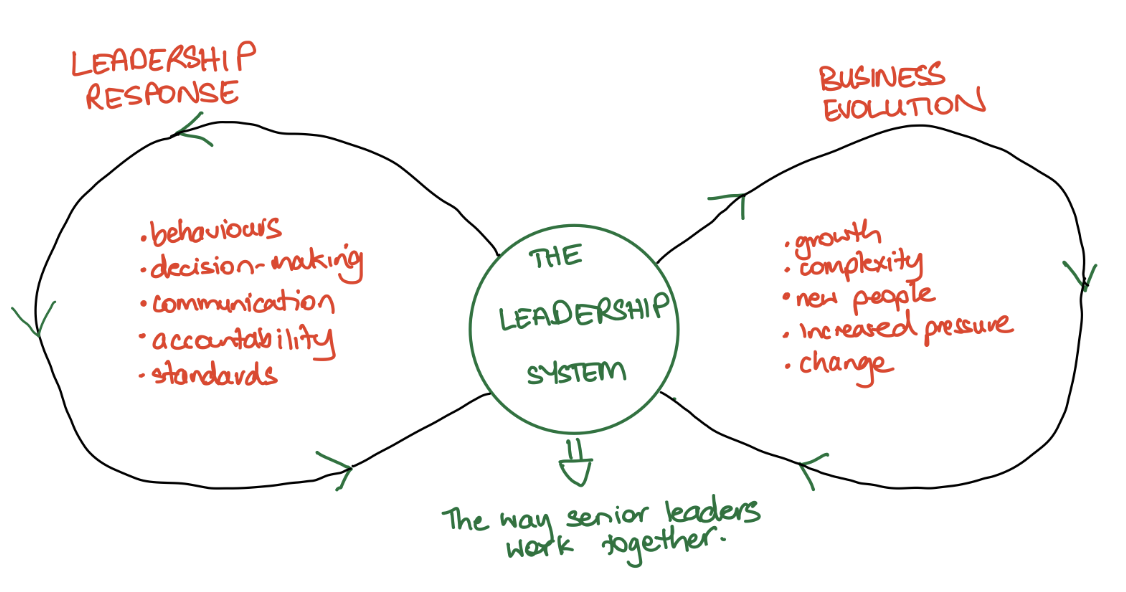
(Source: Deb Bailey Ltd: The Leadership System connects leadership response with the changing needs of the business)
Every business has a leadership system. The question isn't whether one exists, but whether it is producing the results the business now needs.
When the Business Changes, the Leadership System Must Change Too
The New Zealand construction sector continues to operate in a changing environment. While recent activity has softened, MBIE's National Construction Pipeline Report indicates that construction activity is expected to recover over the coming years. As businesses move through different stages of the cycle, the leadership responses required to sustain performance also need to evolve.
One of the patterns I see in growing construction businesses is that leaders continue relying on leadership responses that served them well when the business was smaller.
As the business grows, projects become more complex, the number of leaders increases and decisions become more interconnected. What worked with twenty people often doesn't work with two hundred.
That isn't because the previous response was wrong. The business has simply reached a point where it needs a different leadership response.
One of my favourite sayings is that every system is perfectly designed to achieve the results it is currently producing.
Leadership systems are no different.
If decisions are slow, accountability is inconsistent or communication is fragmented, those outcomes are telling you something about the leadership system sitting behind them.
Sometimes the answer is to strengthen the disciplines that have drifted. Sometimes the business has evolved to the point where the leadership system itself needs to evolve. One response isn't better than the other. The important thing is recognising which one the business needs now.
The Leadership System in Action
A healthy leadership system doesn't remove pressure. It helps leaders respond consistently when pressure increases or when the business enters a new stage of growth.
You will often recognise a healthy leadership system through everyday disciplines such as:
Clear decision making and agreed decision rights
Shared priorities across the senior leadership team
Consistent communication throughout the business
Regular conversations about progress, not just activity
Accountability that extends across the leadership team, not only within individual functions
None of these disciplines are particularly complicated. The challenge is maintaining them as the business grows and becomes more complex.
A Leadership Question
If your business has changed significantly over the past few years, consider this:
Has your leadership response evolved at the same pace?
Or are you still relying on ways of leading that suited a much smaller and less complex business?
Because sustained performance isn't simply about having capable leaders.
It's about having a leadership system that helps those leaders continue making good decisions together as the business evolves.
Letting Go Is Part of Leadership Development
One of the more difficult shifts for experienced leaders is recognising that developing others often requires changing their own behaviour first.
When pressure increases, it is very easy to step back into solving problems, making decisions or taking work away from others because it feels quicker in the moment.
Unfortunately, every time that happens, someone else loses the opportunity to build capability.
Leadership depth grows when responsibility is transferred deliberately, expectations are clear and support is available without removing ownership.
That often requires patience, but it is one of the most valuable investments a leadership team can make.
A Final Thought
Growth doesn't simply ask more of leaders.
It asks something different.
Like the suspension on a vehicle continually responding to the changing road beneath it, effective leadership systems continually respond to the changing needs of the business. They don't eliminate pressure or complexity. They help senior leadership teams stay aligned, make better decisions and adapt with confidence as conditions change.
As the business evolves, the leadership response evolves. As the leadership response evolves, the business is better prepared for its next stage of growth.
That is how leadership systems contribute to sustained performance.
Need Some Help?

If this issue has prompted you to think about how aligned your senior leadership team really is, it may be worth taking a closer look.
Every business already has a leadership system. The question is whether it is producing the outcomes the business now needs.
The Blueprint Leadership Discovery helps senior leadership teams understand how their current leadership system is influencing decision making, alignment, accountability and execution. From there, it becomes much easier to decide whether the right response is to strengthen the disciplines that have drifted or evolve the leadership system to support the next stage of growth.
If the ideas in this issue have resonated with you, you can download the Blueprint for Sustained Performance Whitepaperto explore the five leadership pillars that underpin sustained performance and profit in growing construction businesses.
If those themes resonate with the opportunities or challenges you are experiencing, the next step is simply a conversation.
If those themes resonate with the opportunities or challenges you are experiencing, the next step is simply a conversation.
Because better results don't often start with working harder, they come from deliberately strengthening the leadership system that sits beneath sustained performance.
See you in two weeks with the next instalment of Blueprint for Sustained Performance.