
Source: Deb Bailey Ltd
Blueprint for Sustained Performance
Issue 20: When The Market Moves, What Happens To Your Leadership?
Blueprint Lens: Industry cycles create the conditions a business has to navigate, but they do not determine how that business will respond. When leaders understand the patterns that shape how they think, decide and behave under pressure, they are better equipped to lead deliberately rather than simply react to the market around them.
Construction does not move in straight lines.
There are periods when pipelines are strong, opportunities are plentiful and businesses are trying to keep pace with demand.
Then conditions change. Work becomes harder to secure. Margins tighten. Clients become more cautious. Decisions take longer and leaders begin looking more closely at cost, capability and risk.Everyone can be capable and everyone can want the business to succeed. Yet the organisation can still find itself receiving mixed messages from the top.
We know these cycles will happen. What we don't know is exactly when they will turn, how quickly they will move or how long the next phase will last.
Which means the leadership challenge isn't predicting the cycle perfectly, it is being able to lead effectively through it.
Growth creates pressure, but so does contraction and both can expose things within a leadership system that were already there.
Standards, decision making, alignment, leadership depth, commercial discipline and how people respond when they feel under pressure.
The market may create the test, but your leadership response determines what happens next.
The Same Building - Different Conditions
Think about a building designed to perform in changing conditions.
On a calm day, it can be difficult to tell much about its structural strength. Everything appears to be doing exactly what it should.
It is when the conditions change that the structure is tested.
Wind loads increase. The ground moves. Pressure is applied differently.
The conditions haven't necessarily created the weaknesses. They have exposed how well the structure was designed to respond to them.
Leadership can work in much the same way.
When the market is favourable, strong pipelines and healthy margins can absorb a surprising amount of inconsistency. When conditions tighten, there is less room for it.
Equally, rapid growth can place enormous pressure on a leadership system as businesses take on more work, promote people quickly, stretch capability and make decisions at greater speed.
Different conditions equal different pressures.
The question is whether your leadership has the structural strength to respond to both. And, importantly, are you aware of the default patterns that may become your blind spots?
Cycles Can Pull Leadership In Different Directions
Expansion and contraction create very different temptations.
When the market is growing, confidence can become overconfidence. Businesses can take on work they might previously have questioned. Pricing discipline can soften. Leadership appointments can be made quickly because capability is desperately needed. Standards that once mattered become harder to hold consistently.
When the market contracts, the pull is different.
Leaders can become overly cautious. Decisions slow down. Investment in people and capability gets pushed out. Short-term protection starts taking priority over positioning the business for what comes next.
Neither response is necessarily deliberate. Often it is simply what happens when pressure activates our natural, and often unconscious, leadership tendencies.
And that is where the inner game of leadership becomes particularly important.
Pressure Doesn't Create Your Leadership Patterns - It Reveals Them
Every leader has behaviour patterns. There are ways we naturally think, communicate and make decisions when we are at our best.
There are also tendencies that are more likely to emerge when pressure increases. For example:
One leader may become more controlling
Another becomes cautious and slows decisions down
Someone else may become overly optimistic and underestimate risk
Another pushes harder, moves faster and becomes less willing to listen to challenge
These aren't necessarily weaknesses. In the right circumstances, many of these characteristics are valuable. In fact, many of them may be strengths. The problem comes when, under pressure, we overplay that strength and it tips into unhelpful territory.
Hogan's research supports this. Its work on leadership derailers shows that behavioural tendencies that may ordinarily be strengths can become problematic when overplayed under stress or pressure. More recent Hogan research reinforces why that matters. Its 2026 Global Leadership Effectiveness Study, drawing on personality data from more than 21,000 executives and responses from 9,794 employees across 25 markets, found that 72% of respondents said emotional volatility and unpredictability negatively affect leadership effectiveness. Extreme caution, arrogance and passive-aggressive behaviour were also identified as behaviours that can undermine leadership effectiveness.
For me, this brings us back to the importance of understanding our own patterns. What may feel like a reasonable response from the inside can be experienced very differently by the people around us.
The issue is knowing what you are likely to default to, particularly when the conditions around you change, because over time, those responses become part of your leadership reputation. That is why self-awareness matters, but it is also why measurement matters.
We are not always the most objective observers of our own leadership. We all have blind spots we don't see and unconscious biases that can influence how we interpret and respond to what is happening around us.
Assessment of our inner game of leadership gives us another source of insight. It can help leaders understand how they are likely to show up at their best, what may emerge under pressure and the motives, values and preferences influencing the decisions they make, the environments they thrive best in and the type of culture they are creating in their business.
Then intuition becomes much more useful.
We can recognise what is happening and make a more deliberate choice about the leadership response the situation actually requires.
The Leadership Response Model
Knowing our default patterns is useful. But insight only becomes valuable when it changes what we do.
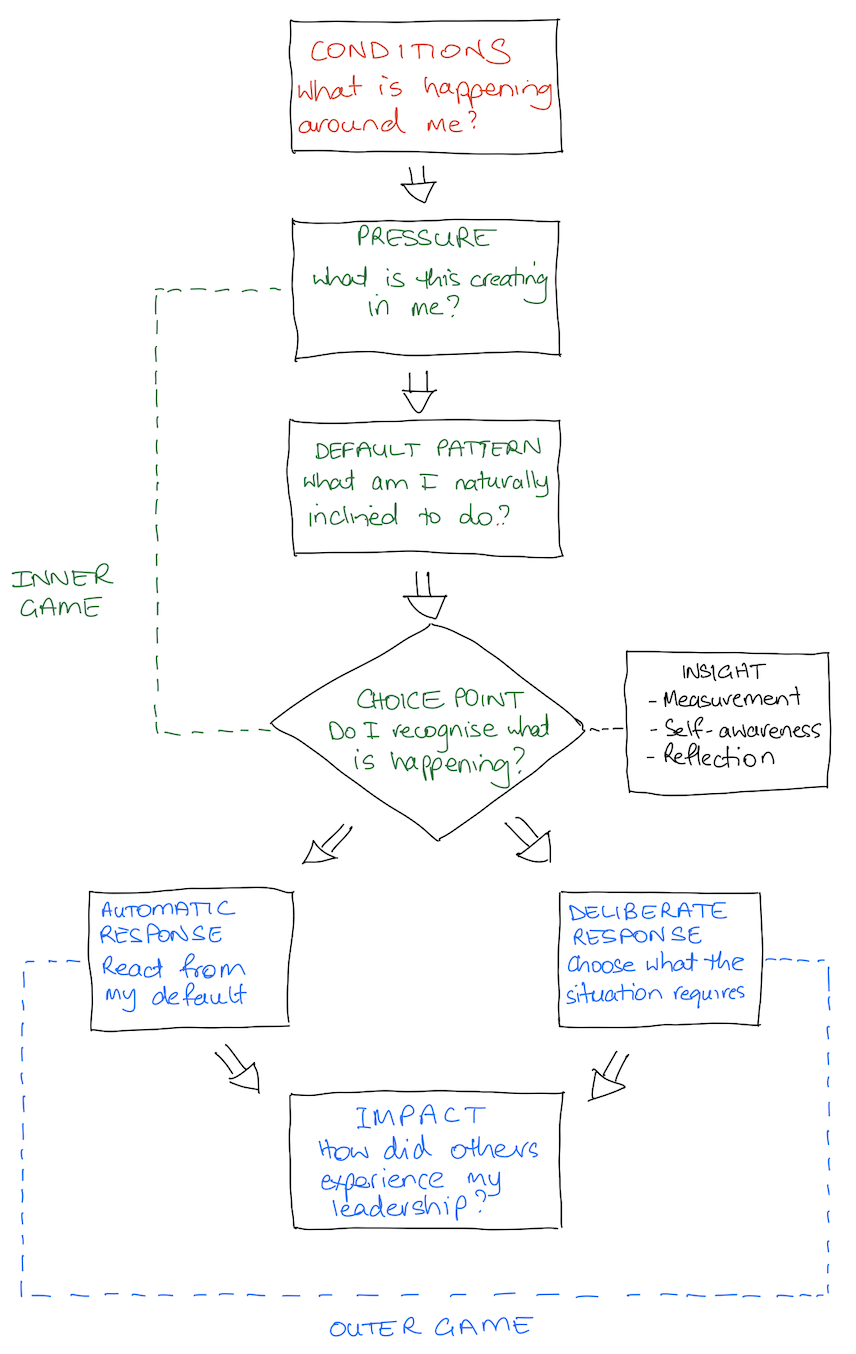
The critical moment is what happens between the pattern being activated and the response that follows.
I think about it through the Leadership Response Model.
The Leadership Response Model
(Source: Deb Bailey Ltd: The Leadership Response Model)
The market conditions are external, but the pressure those conditions create in us is internal. That pressure can activate the default patterns that sit within our inner game of leadership.
The Choice Point is where insight becomes particularly valuable.
If I don't recognise the pattern that has been activated, there is a greater chance I will simply respond from it. That response may work, but it may also mean I overplay a strength, react more strongly than the situation requires or create an impact I didn't intend.
Insight doesn't remove our natural tendencies, but it gives us greater choice about what we do with them.
And importantly, both pathways lead to Impact.
Because regardless of what we intended, other people experience our leadership through what we actually say and do. Over time, those experiences contribute to our leadership reputation.
This is where the inner game and outer game of leadership connect.
The more insight we have into what is happening on the inside, the greater our opportunity to make a deliberate choice about what happens on the outside.
That is what builds structural strength in leadership.
From Individual Insight to Collective Strength
Of course, construction businesses aren't typically led by one person. Every member of the senior leadership team brings their own leadership patterns into the room.
One may respond to uncertainty by wanting more information
Another wants to make the call and move
One becomes increasingly focused on protecting risk
Another sees the downturn as an opportunity to invest
None of those responses is automatically right or wrong. But imagine what changes when the team understands the patterns sitting underneath them.
Instead of simply reacting to one another, they can recognise what may be driving the different responses around the table and that creates the opportunity for better conversations.
Are we being appropriately cautious, or has caution begun slowing decisions we need to make?
Are we seeing an opportunity others haven't, or are we underestimating the risk?
Are we protecting the business, or cutting into capability we will need when conditions change again?
This is where individual insight starts becoming collective leadership strength.
Structural Strength Shows Up in the Leadership System
Understanding the inner game isn't the end point. It should change what happens in the business.
You begin to see it in clearer priorities, more considered decision making and better conversations around risk.
You see it in senior leaders who can challenge one another without immediately becoming defensive. You see leadership capability being developed before it is urgently needed and you see standards being maintained when there is pressure to compromise them. And you see a business that is less dependent on one or two individuals to hold everything together.
This is structural strength: the ability of the leadership system to absorb changing conditions without losing the things that matter most.
Questions Worth Asking
Take a few minutes today with no interruptions and answer these questions for yourself:
If the market changed significantly tomorrow, what would it expose about your leadership?
When pressure increases, what are your own default leadership patterns and how might others experience them?
What patterns emerge collectively across your senior leadership team when uncertainty increases?
And perhaps most importantly:
Do you have enough insight into your leadership today to choose how you want to respond tomorrow?
A Final Thought
Industry cycles are external.
Your leadership response is not, it’s internal.
You cannot control when the construction market expands, contracts or changes direction. But you can build greater insight into how you and your senior leadership team are likely to respond when it does.
For me, that is a more useful way to think about ‘resilience’.
It isn't simply about becoming better at enduring difficult conditions.
It is about building structural strength into leadership so that when conditions change, leaders have the insight, capability and discipline to decide what the situation requires rather than simply defaulting to what comes naturally.
The stronger the inner game of leadership, the greater the opportunity to influence the outer game results.
Need Some Help?

If this article has prompted you to think about how you or members of your senior leadership team respond when pressure increases, that is something we can measure and gain clarity on.
My Inside Out Leadership work uses validated leadership assessment to provide insight into how leaders are likely to show up at their best, the tendencies that may emerge under pressure and the motives and preferences influencing how they lead.
For an individual leader, that can provide a powerful starting point for understanding their own leadership patterns.
Across a senior leadership team, it can also help make sense of the different responses that appear around the table when the business is navigating pressure, change or complexity.
If you would like to learn more, go to my contact page to send me a message, or give me a call on 021 387 731.
See you in two weeks with the next instalment of Blueprint for Sustained Performance.