
Source: Deb Bailey Ltd
Blueprint for Sustained Performance
Issue 19: When Alignment at the Top Matters Most
Blueprint Lens: Alignment within the senior leadership team matters, but it can only take the business so far if owners, the board and senior leaders are working from different assumptions. Sustained performance requires shared direction at the top, clarity about the boundaries within which the business will operate and confidence about who has the authority to decide what.
As construction and infrastructure businesses grow, leadership becomes more complex. Ownership structures evolve and Boards or Advisory Boards are introduced. Independent directors may join, Founders begin to step back from some decisions and senior leaders take greater responsibility for running the business.
Done well, those additional layers bring valuable perspective, challenge and governance. But they also create another potential source of misalignment.
The owners may have one view about where the business is heading
The board may have another view about the level of risk it should take
The CEO and senior leadership team may be making decisions based on a different understanding again
Everyone can be capable and everyone can want the business to succeed. Yet the organisation can still find itself receiving mixed messages from the top.
Perhaps strategy gets revisited or investment decisions stall. Senior leaders become unsure how much authority they really have and decisions that appeared to have been made find their way back around the table.
People further down the organisation begin trying to work out whose direction matters most.
This is why alignment at the top is not simply a governance issue, it is a performance issue.
Are You Working From the Same Plan?
There is a useful construction analogy here. Think about the drawings required to deliver a complex project.
Architectural drawings have one purpose. Structural drawings another. Services drawings add another layer again.
Each discipline can produce excellent work in isolation, but if the drawings haven't been properly coordinated, the problems eventually appear on site. A service clashes with a structural element or clearances don't work. Something needs to be moved and work stops while the clash is resolved.
The problem isn't necessarily the quality of the individual drawings. The problem is that they weren't aligned before execution began.
Leadership can work in much the same way.
Owners, boards and senior leaders have different roles and they should bring different perspectives. Alignment doesn't mean everyone seeing the business through the same lens, it means those different perspectives are coordinated around a shared understanding of what the business is trying to achieve.
Because when they aren't, the leadership clashes eventually show up somewhere else in the business.
Different Roles. Shared Direction.
Owners, boards and senior leaders naturally look at the business differently.
Owners may be thinking about return, legacy, growth, succession, capital and how much risk they are personally prepared to carry.
Boards provide governance, oversight and challenge while considering the longer-term interests and resilience of the business.
The CEO and senior leadership team are closer to execution. They are translating strategic direction into decisions about people, projects, clients, capability, investment and performance.
Those different perspectives are useful. In fact, they are necessary.
The problem starts when the assumptions sitting underneath them haven't been made explicit.
What does growth actually mean for us? How much risk are we prepared to take? What margins are we committed to protecting? What are we prepared to invest today to build the capability we will need tomorrow? And what does success look like in three to five years?
These are strategic questions but they are also alignment questions.
The Institute of Directors' 2025 Director Sentiment Survey provides an interesting insight into the difference between having conversations at the top and creating genuine alignment. While 73.9% of directors said their boards discuss and monitor organisational culture, only 51.9% said they ensure alignment between board and organisational culture.
That gap matters. Discussing strategy, culture or performance at the top doesn't necessarily mean everyone is aligned around what it requires in practice.
Conversation creates understanding. Alignment creates consistency.
The Leadership Alignment Triangle
Having different perspectives around the table is valuable. Owners, boards and senior leaders should not think about the business in exactly the same way. Each brings a different responsibility, perspective and time horizon.
The challenge is making sure those perspectives remain connected.
Alignment at the top isn't created simply by having the right people around the table or having regular conversations. It comes from being clear about what each group brings, what needs to be shared and where healthy challenge makes the thinking stronger.
I think about this through the Leadership Alignment Triangle.
The Leadership Alignment Triangle
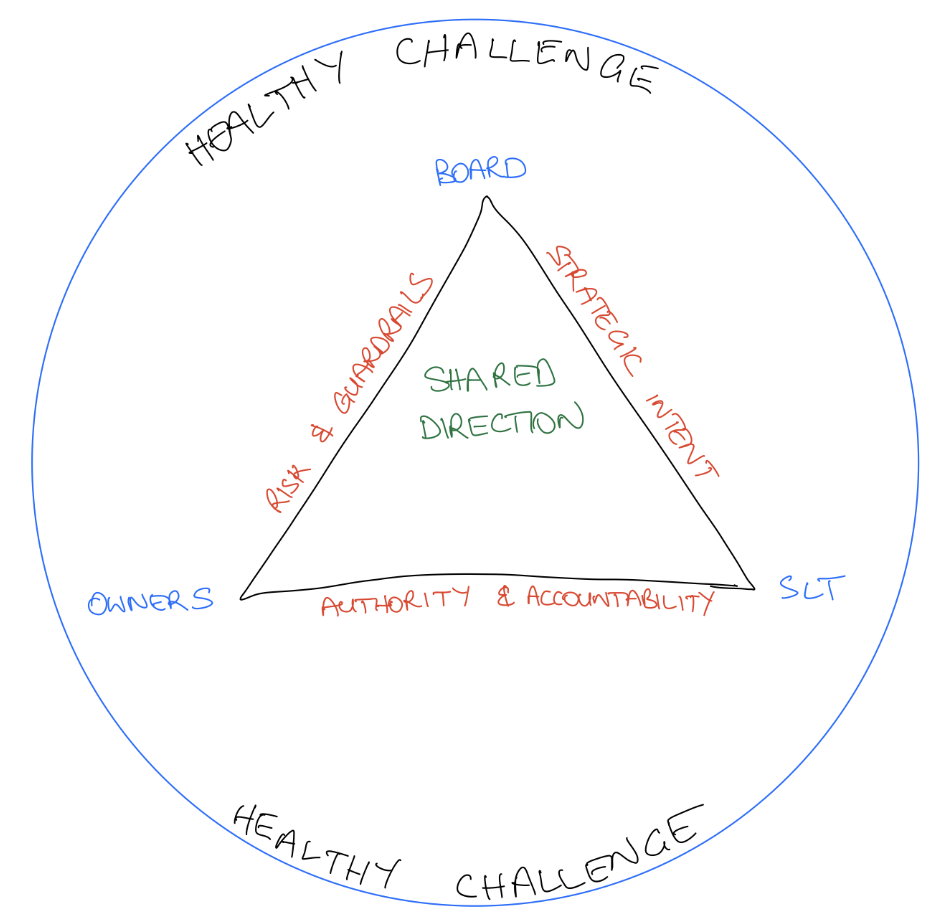
(Source: Deb Bailey Ltd: The Leadership Alignment Triangle)
Depending on the ownership and governance structure of the business, these may not always be three distinct groups. In some businesses, ownership and governance overlap; in others, the board effectively represents the ownership perspective. What matters is that the perspectives of ownership, governance and executive leadership are clear and connected.
Owners
What do we want from the business?
Owners may be thinking about return, purpose, time horizon, legacy and the level of risk they are prepared to carry.
Board
What do we need to protect and govern?
The board brings governance, oversight and challenge, with responsibility for risk, performance expectations and the longer-term interests of the business.
Senior Leadership Team
What do we need to deliver?
The senior leadership team translates direction into strategy, priorities, people decisions, execution and performance.
None of these perspectives is more important than the others, but they need to meet somewhere.
At the centre of the triangle sits Shared Direction.
The question at the centre is:
Are we leading the same business towards the same outcome?
Genuine shared direction requires alignment across three important conversations.
1. Strategic Intent
Are we aligned on where we are going?
Could the owners, board and senior leadership team independently describe what success looks like over the next three to five years and give broadly the same answer?
Are you aligned on the type and pace of growth you want and what matters beyond revenue?
2. Risk & Guardrails
Are we aligned on the boundaries within which we will get there?
How much risk are you prepared to take and what margins are you committed to protecting?
What won't you compromise to achieve growth and what are you prepared to invest today to build the capability the business will need tomorrow?
If these things haven't been discussed explicitly, people will fill the gaps with their own assumptions.
3. Authority & Accountability
Are we clear about who decides and who delivers?
Where does governance end and management begin, and which decisions belong with the board versus the CEO and senior leadership team?
When does an owner need to be involved and, once a decision has been made, who is accountable for delivering the outcome?
One of the simplest ways to test this is to follow the decisions, which decisions keep finding their way back to the same person?
If decisions continually move backwards and forwards, are revisited or return to the person who has historically held the authority, the issue may not be decision quality. It may be decision clarity.
4. Healthy Challenge Holds It Together
Around the outside of the Leadership Alignment Triangle sits Healthy Challenge and that is deliberate. Alignment should never mean agreement on everything.
Owners should be able to challenge whether the business is delivering what they need from it. Boards should test assumptions and question risk. CEOs and senior leaders should be able to push back when expectations are unrealistic or governance begins moving too far into management.
The goal is productive tension within shared direction and when that exists, challenge strengthens the triangle. When it doesn't, healthy challenge can gradually become leadership friction.
When Healthy Challenge Becomes Leadership Friction
Healthy challenge tests assumptions and strengthens decisions.
Friction is different. It occurs when the same issues keep returning because the underlying expectations have never really been resolved.
The board approves a strategy and then repeatedly questions the decisions required to execute it. Owners want growth but become uncomfortable with the investment required to support it. The SLT believes it has authority but discovers significant decisions are still being made elsewhere.
Eventually leaders start second-guessing what will actually be supported.
That slows decisions and weakens accountability because it is difficult to hold someone accountable for an outcome if they are unclear about the authority they have to achieve it.
Which Hat Are You Wearing?
For founder-led and privately owned construction businesses, there can be another complication.
The same person may be an Owner, Director and CEO. Sometimes they remain an operational leader as well.
There is nothing inherently wrong with that. The challenge is knowing which hat is being worn in which conversation.
A decision may appear to have been made by the senior leadership team, only to be overturned later by the owner. A board discussion can drift into operational problem solving. Senior leaders can become unsure whether they are being asked for a recommendation or being given an instruction.
Over time, that ambiguity can reduce both confidence and ownership.
This connects directly with the leadership depth we explored in the previous issue. As businesses mature, leadership needs to become less dependent on individuals and increasingly supported by clear leadership systems.
Governance is part of that system.
Alignment Has to Travel Downwards
Misalignment at the top doesn't stay there.
People notice when priorities change unexpectedly, when one senior leader says yes and another says no, or when a strategy is communicated but subsequent decisions appear inconsistent with it.
Eventually people begin compensating.
They wait. They check. They seek another opinion. They avoid making decisions that might later be overturned.
That is where a governance issue becomes an execution issue and ultimately, a commercial one.
The clearer the direction at the top, the easier it becomes for the rest of the organisation to move with confidence.
Questions Worth Asking
If you want to test alignment at the top of your business, start here:
Could your owners, board and senior leadership team independently describe the business you're trying to build and give broadly the same answer?
Are your expectations around growth, risk, margin and investment genuinely understood, or are some simply assumed?
Is it clear which decisions belong with owners, the board and the senior leadership team?
Is healthy challenge strengthening your decisions, or are unresolved expectations creating friction?
And perhaps the most important question:
Are we genuinely aligned on the business we are trying to build?
A Final Thought
Alignment at the top does not mean removing disagreement. Some of the best strategic decisions emerge because people with different perspectives are prepared to challenge one another.
But challenge works best when it happens within a shared understanding of direction, expectations and decision rights.
Owners need clarity about what they want from the business. Boards need clarity about what they are there to govern. Senior leaders need clarity about what they have the authority and accountability to deliver.
When those perspectives are coordinated, the organisation can move with greater confidence. When they aren't, the clashes eventually show up downstream.
Sustained performance requires more than an aligned senior leadership team. It requires alignment across the people who own, govern and lead the business.
Need Some Help?

If this article has prompted you to think about alignment between your owners, board and senior leadership team, I’d welcome a conversation. We can explore what you are noticing, where expectations or responsibilities may be unclear and what support could help.
Where a deeper understanding is needed, the Blueprint System Discovery provides a structured diagnostic process to examine the leadership patterns influencing performance and translate those insights into a clear Leadership Response Roadmap.
For founders, CEOs and senior leaders, that can also mean looking at your own leadership. Are you clear about when to step in, when to challenge and when to give others the authority to lead? Through 1:1 executive coaching, I work with leaders to understand how their own patterns influence the people around them and what they could do differently to strengthen clarity, confidence and accountability.
If you would like to learn more, go to my contact page to send me a message, or give me a call on 021 387 731.
See you in two weeks with the next instalment of Blueprint for Sustained Performance.