
Source: Deb Bailey Ltd
Blueprint for Sustained Performance
Issue 15: The Hidden Influence Behind Every Strategic Decision
Blueprint Lens: Strategy is never created in isolation. It is influenced by the leadership team, enabled by the leadership system and ultimately shaped by the judgement of the people making the decisions. Understanding your own leadership patterns helps ensure strategy reflects the needs of the business rather than simply the preferences of its leaders.
In the last issue, we explored why leadership systems need to evolve as businesses grow. Strong leadership systems create consistency, alignment and disciplined execution.
But even the best leadership system depends on the quality of the decisions being made within it.
Which brings us to another influence that often goes unnoticed.
The Leader Shapes the Strategy
Every leader brings natural tendencies to the way they think, make decisions and solve problems.
Most leaders believe they are making objective decisions. In reality, every decision is filtered through how we naturally see the world.
This is one of the central ideas behind Inside Out Leadership. Our inner game influences our outer game, often more than we realise.
Think about it like a pair of safety glasses on a construction site. Two experienced leaders can stand in exactly the same place, looking at exactly the same project, yet notice different things. One immediately sees opportunity. Another sees risk. One focuses on the commercial upside. Another notices the operational implications. Neither is necessarily right or wrong; they're simply interpreting the same situation through different lenses.
Leadership works much the same way.
We all see the same business, but what we've learned over time and what comes naturally to us influences what we notice, how we interpret it and ultimately the decisions we make.
What Shapes Leadership Judgement?
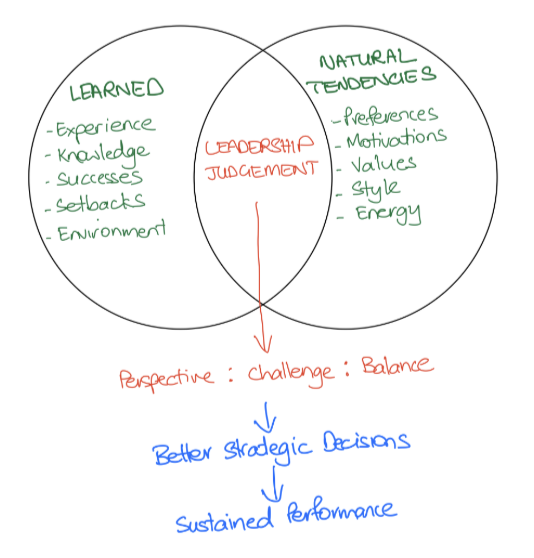
(Source: Deb Bailey Ltd: What Shapes Leadership Judgement)
Leadership judgement is shaped by both what we've learned and our natural tendencies. The better we understand their influence, the better our strategic decisions become.
Some leaders are naturally opportunity focused. They quickly see possibilities for expansion, diversification and new markets.
Others are naturally more cautious. They focus on protecting margin, managing risk and building stability before pursuing growth.
Some make decisions quickly and confidently, some would say intuitively, while others prefer to gather perspectives, test ideas and data before committing.
None of these approaches are right or wrong. The challenge is that we often assume others see the situation the way we do.
They don't.
This is why there is so much value in a senior leadership team understanding both their individual and collective leadership patterns.
An opportunity-focused leader may push into new sectors before the organisation is ready
A more cautious leader may delay investment until opportunities have passed
A fast decision maker may not invite enough constructive challenge
A leader who naturally seeks consensus may unintentionally dilute clarity while trying to bring everyone with them. Equally, not every decision needs to be made collectively. Part of mature leadership is knowing which decisions require broad discussion and which can be made confidently by an individual leader without compromising alignment.
The Value of Collective Awareness
Pressure has a way of amplifying how we naturally lead and over time, those preferences begin to influence the direction of the business.
The risk is not personality itself. The risk is allowing our natural leadership patterns to shape strategic direction without sufficient awareness or balance.
A strong leadership system helps create that balance.
When leaders understand both their own leadership patterns and those of the wider senior leadership team, strategic discussions become richer. People recognise where healthy challenge is likely to come from, become less defensive because differences are expected rather than personalised, and the quality of debate improves.
Why does this matter?
Because clear decision-making processes, healthy challenge and disciplined debate reduce the likelihood that one person's natural preferences, or those of a dominant subgroup within the leadership team, become the organisation's strategy.
As businesses grow, strategic decisions become more significant
Investment decisions involve greater commercial risk
Market positioning becomes increasingly important
Succession planning carries longer-term consequences
The quality of leadership judgement matters more because the impact of every major decision becomes greater.
Questions Worth Asking
Leadership judgement improves when leaders become curious about how they are thinking, not just what they are thinking.
As a senior leadership team, these are useful questions to reflect on:
Whose perspective around this table is most different from mine, and have I genuinely explored it?
Do our strategic discussions encourage healthy challenge, or do we tend to reinforce the views of the loudest or most influential voices?
Where might our natural leadership patterns be creating blind spots in the decisions we're making?
If someone observed our strategy discussions, what would they say influences our decisions most?
Leadership patterns are not something to remove from strategy but they are something to understand.
Leaders who understand the influence of their own leadership patterns deliberately surround themselves with people who see the world differently. It helps them to slow down where they naturally move quickly or they stretch themselves where they naturally become cautious. They also intentionally seek perspectives that challenge their own thinking because they understand that every leader has strengths, and every strength has potential blind spots.
It's easy to assume our strategy is simply a response to the market, but strategy is never shaped by market conditions alone. It is also shaped by the judgement of the leaders interpreting those conditions.
Before looking outward for all the answers, spend some time looking inward.
Because sustained performance depends not only on making good strategic decisions, but understanding what influences those decisions in the first place.
Research Insight
Research from Korn Ferry in 2022 that I think is still relevant today, found that self-awareness is the number one coaching focus for executive and senior leaders, ahead of influence, leading through change, communication and strategy. As the complexity of leadership grows, understanding how your own patterns influence decisions has become a leadership capability in its own right.
A Final Thought
Every strategy carries the imprint of the leaders shaping it.
When leaders understand the patterns influencing their judgement, the quality of their strategy improves. When they don't, blind spots become much harder to see.
The most resilient construction businesses are not those without strong personalities at the top. They are those where leaders understand their own patterns, invite constructive challenge and create the conditions for better decisions. Because the better we understand our inner game of leadership, the stronger our outer game becomes.
Need Some Help?

Every leadership team develops patterns over time. Some strengthen decision quality. Others create blind spots that become more significant as the business grows.
Through executive coaching, leadership diagnostics and senior leadership team facilitation, I help leaders understand the patterns shaping their decisions, strengthen strategic thinking and create the conditions for sustained performance.
If you haven’t worked with a coach before, or you’re not sure whether coaching is right for you, my complimentary Leading with Impact self-assessment is a useful place to start. It uses the Leader’s Dashboard tool from my coaching programme to help you reflect on where you are now and where you may want to focus.
Because better strategy doesn't start with working harder, it starts with understanding the leaders making the decisions.
See you in two weeks with the next instalment of Blueprint for Sustained Performance.