
Source: Deb Bailey Ltd
Blueprint for Sustained Performance
Issue 14: Growth Without Chaos
Blueprint Lens: Every stage of growth asks something different of a leadership team. The leadership approaches that supported success in one phase of the business are not always enough for the next. Sustained performance depends on leaders evolving before the business outgrows them.
Growth is the goal for most construction businesses. The idea of having more projects, greater capability and stronger revenue, inspires us to create strategic plans that hold more opportunities.
But somewhere along the way, many leaders discover that growth doesn't simply make the business bigger. It changes the way the business needs to be led.
In the previous issues of Blueprint for Sustained Performance, we've explored leadership drift, senior leadership team alignment and the importance of building a leadership system that supports consistent execution. Growth places pressure on all three.
Every stage of growth asks something different of a leadership team.
The conversations that worked when there were 40 people often aren't enough when there are 140 people across multiple teams with a more layered leadership structure.
The informal decision making that once kept the business moving and made it feel agile eventually starts slowing it down. Things begin to fall through the cracks.
Leadership has to evolve at the same pace as the business.
But how often do we stop and ask what actually needs to change?
Changing Gears
Think about driving a manual car.
As your speed increases, you naturally change gears.
First gear gives you the power you need to get moving, but it isn't designed for open-road driving.
If you stay in first gear, the engine works harder, becomes noisier and eventually struggles to perform. Imagine trying to head down the motorway, doing 100km in first gear!
Growing a business is much the same.
The leadership approaches that helped build the business are not always the ones that will help it scale.
Every stage of growth requires leaders to shift gears.
The question isn't whether your business is growing, it's whether your leadership is evolving with it.
The Leadership Evolution Curve
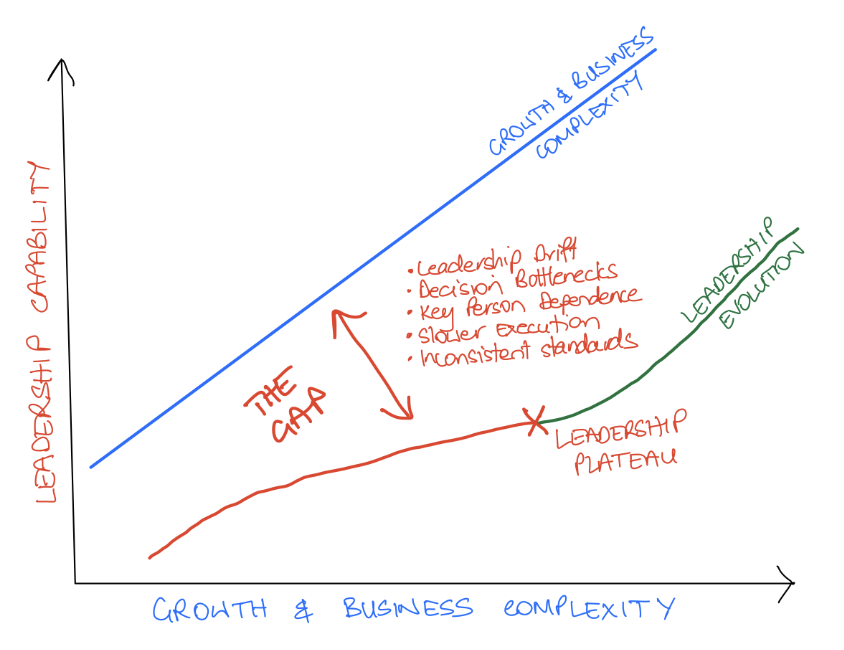
(Source: Deb Bailey Ltd: The Leadership Evolution Curve)
The point where business complexity begins to outpace leadership capability is where growth starts to feel harder than it should. The good news is that it also marks the opportunity to evolve the way the business is led.
Growth Reveals Leadership Capability
Growth doesn't create leadership capability, it reveals it.
As complexity increases, leadership drift becomes easier.
Senior leaders naturally become absorbed in the challenges of their own functions. Enterprise conversations become shorter, or become limited to just a few people which means other SLT members are simply unaware of how they could or should be contributing to those decisions. Functional conversations become longer and increasingly detailed. Alignment across the senior leadership team becomes harder to maintain which unconsciously drives everyone back into their silos where they feel they have more control.
The business has changed. The way it's being led often hasn't and that's where the pressure begins to build.
What worked at $20 million doesn't automatically work at $60 million, and it won't necessarily work at the next stage of growth either.
Communication becomes more complex
Decision making becomes slower
Standards become harder to apply consistently.
Founders and senior leaders often find themselves carrying more decisions than they should, pulling them back into the operational firefighting they have been trying to move beyond.
Without deliberately evolving the way the business is led, growth begins to create unnecessary complexity.
At first, it doesn't feel like chaos. It looks more like shifting priorities, competing demands, inconsistent project outcomes and increasing uncertainty about who owns what.
The organisation becomes busier but not necessarily more effective.
From Solving Problems to Building Leadership
One of the biggest shifts leaders make as their business grows is moving from solving problems personally to creating the conditions where good leadership can happen throughout the business.
That means building greater clarity around decision making and strengthening consistent standards across teams. We also want to ensure senior leaders stay aligned on what matters most across the business, not just within their own functions. How can we create regular opportunities to step above the day-to-day operation and lead the business strategically, not just operationally? That’s a question worth asking.
Growth doesn't ask leaders to work harder, it asks them to lead differently.
Yet when pressure increases, our natural tendency is often to hunker down, work harder and spend even more time in our own part of the business.
Ironically, that's often the point where the business most needs its leaders to think collectively.
A Question Worth Asking
If your business is growing or transitioning in some way, take a moment to reflect.
Has your leadership evolved at the same pace as your business?
If you were starting the business again today at its current size, what would you do differently in the way you lead it?
Would your decision making look the same?
Would accountability sit in the same places?
Would your senior leadership team spend their time having the same conversations?
Growth should increase capability and resilience, not complexity and stress.
Because sustainable growth requires more than ambition and hard work.
It requires leadership to evolve.
A Final Thought
Revenue growth is easy to measure but leadership strain is much harder to see.
If growth feels a bit harder than it should, the issue may not be the opportunity itself.
It may be that the business has outgrown the way it is currently being led.
Businesses that continue to perform well don't simply grow, their leadership evolves with them.
Need Some Help?

If this article has prompted you to reflect on whether your leadership has evolved alongside your business, there are several ways we can explore that conversation.
If you're looking at the business as a whole, the Blueprint Leadership Discovery helps identify where your leadership system is supporting sustained performance and where it may need to evolve. The outcome is a clear Leadership Response Roadmap, giving your senior leadership team clarity on the priorities that will have the greatest impact.
If your senior leadership team has grown and you're wondering whether it's operating as effectively as it could, Decoding Team Performance provides an objective way to measure team alignment, decision making and collective leadership.
And if your own leadership has changed significantly as the business has grown, one-to-one executive coaching provides the opportunity to step back, strengthen your leadership approach and navigate the next stage of growth with greater clarity and confidence.
Because sustainable growth doesn't happen by chance.
It happens when leadership evolves before the business outgrows it.
See you in two weeks with the next instalment of Blueprint for Sustained Performance.