
Source: Deb Bailey Ltd
Blueprint for Sustained Performance
Issue 18: Succession Starts Long Before Someone Leaves
Blueprint Lens: Succession planning is not about replacing people. It is about building the leadership depth that allows the business to keep performing without depending too heavily on any one person.
Succession planning is not simply about who will take over when someone leaves.
It is about building enough leadership depth that the business can continue to perform when people move on, step up or step away.
When leaders deliberately develop capability around them, leadership depth increases and dependency reduces.
Succession is not just a future leadership issue. It is a present performance issue.
How Dependent Is Your Business?
If one of your senior leaders resigned tomorrow, what would your business lose?
Their technical expertise?
Their client relationships?
Their ability to solve the problems that nobody else seems able to solve?
Or something even more valuable?
Most businesses would recover. Given enough time, someone else would step into the role. But that is not really the question. The better question is this:
Why does so much depend on one person in the first place?
Recent research from Korn Ferry reinforces this point. In its 2026 CEO and Board Survey, 50% of board members said succession planning had started too late during their organisation’s last CEO transition. While 60% believe succession planning works best when it is treated as an ongoing process, only 17% review succession plans quarterly.
If succession planning begins when someone announces they are leaving, you are already responding to the risk rather than managing it.
Succession Is About Leadership Depth
Succession planning is often associated with retirement, ownership transition or replacing a senior leader.
Those situations matter, but succession planning needs to go much further than that. At its heart, it is about building leadership depth throughout the business.
It is about ensuring knowledge is shared, capability is developed, decisions can continue to be made and the business does not become overly dependent on a handful of people.
Because dependency creates risk.
As businesses grow, key people can gradually accumulate more knowledge, more authority and more responsibility. They become the person everyone turns to.
Initially, that feels like a strength, but over time it can become a constraint.
There is a useful construction analogy here.
Think about scaffolding. While a structure is being built, scaffolding provides essential support. But the finished building should not depend on the scaffolding to remain standing.
Leadership can work in much the same way. A founder, CEO or experienced senior leader may have provided enormous support while the business was being built. They have carried knowledge, relationships, judgement and responsibility that helped the organisation grow.
But as the business matures, the structure underneath needs to become stronger. The real test is whether the business can eventually stand without depending on that support.
Good succession planning is not about removing the scaffolding. It is about making sure you are building enough strength underneath it.
The Leadership Depth Staircase
From Dependency to Organisational Resilience
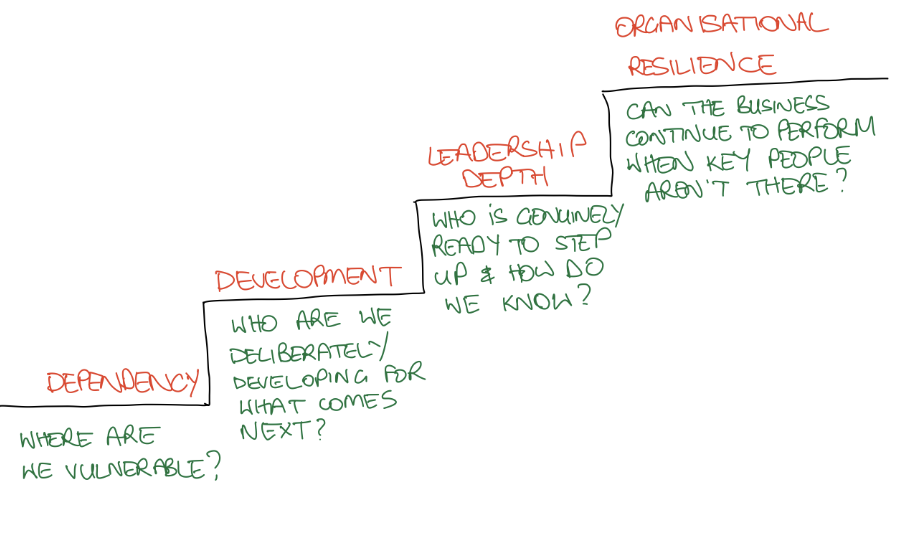
(Source: Deb Bailey Ltd: The Leadership Depth Staircase)
Moving from dependency to resilience takes deliberate development.
It means giving people exposure before they are needed, involving them in bigger decisions, broadening relationships and allowing them to build their own judgement.
Development is what leaders do. Leadership depth is what the business gains as a result.
And the greater that depth becomes, the less vulnerable the business is when someone moves on, steps up or steps away.
Great Leaders Build Capability Around Them
One of the characteristics I see in high-performing construction businesses is that their best leaders are constantly developing the people around them.
They involve others in significant conversations. They delegate decisions, not just tasks. They share their thinking. They coach people through problems instead of immediately providing the answer and they deliberately create opportunities for others to lead.
Over time, this creates something incredibly valuable.
Leadership capability that exists throughout the business rather than sitting with a few individuals.
That is what gives organisations resilience and it changes the succession conversation.
Instead of simply asking:
Who could replace this person?
We start asking:
Where are we deliberately building the capability our business will need next?
The Founder’s Leadership Shift
For many founders and long-standing business owners, this can be one of the biggest leadership transitions.
In the early years, success often depended on being personally involved in everything that mattered.
Making the decisions
Building the relationships
Solving the difficult problems
That leadership response may have been exactly what the business needed at that stage.
As the business grows, however, the leadership response needs to evolve.
The question changes from:
How much can I do?
to:
How much capability am I building in others?
This is an important shift because if the business can only perform when particular people are present, it has not yet built the leadership depth required for sustained performance.
Reducing Key-Person Dependency
Every construction business has people who carry significant knowledge, relationships and experience.
That is not the problem.
The risk comes when too much depends on them.
Consider what happens when an experienced leader takes extended leave, moves into another role or leaves the business altogether.
Does someone else understand the client relationship?
Can another leader make the decisions they would normally make?
Has their knowledge been shared?
Have other people had enough exposure to develop their own judgement?
Or does everything simply wait until they return?
Succession planning gives us an opportunity to identify these dependencies before circumstances expose them for us. And this is why succession needs to be thought about as more than identifying a name underneath each senior role on an organisation chart.
A nominated successor does not necessarily mean you have succession depth and succession should not simply be about finding someone who can replicate the leader already in the role. As the business evolves, the leadership capability it needs will evolve too. The experience, thinking and leadership approach that got the business here may not be what it needs to take it where it wants to go next.
So the question is not only:
Who could step into this role?
It is also:
What will this role need to deliver in the future, and what leadership capability will that require?
The real question is whether you are developing people with enough exposure, responsibility, feedback and opportunity to build the judgement and capability the business will need when the time comes.
Questions Worth Asking
Imagine one of your senior leaders was unavailable for the next three months.
What would continue without interruption?
Where would decisions begin to slow?
Which client or stakeholder relationships would become vulnerable?
Who is genuinely ready to step into greater responsibility?
What leadership capability have you deliberately built over the past 12 months?
What leadership capability will your business need in the next three to five years that it doesn't have enough of today?
And perhaps most importantly:
Where is your business still too dependent on one person?
The answers will tell you a great deal about the leadership depth within your business.
A Final Thought
Succession planning is not about replacing people. It is about strengthening the business.
The goal is not to make good leaders less valuable. It is to make sure their value is being multiplied through the people around them.
But succession also needs to look forward.
Succession should build the leadership capability your business is going to need, not simply replace the leadership capability it has today.
Because sustained performance should never depend on one exceptional leader. It depends on building the leadership depth and capability that will allow the business to continue to perform, evolve and respond to whatever comes next.
Need Some Help?

If this article has prompted you to think about where your business is too dependent on one or two key people, that is a useful place to start.
Succession planning is not simply about identifying who could step into a role. It is about understanding where capability needs to be built now so your business is stronger and more resilient in the future.
For founders, CEOs and senior leaders, that can also mean looking at your own leadership. Where are you still holding onto decisions, relationships or responsibilities that others need the opportunity to develop? Through 1:1 executive coaching, I work with leaders to understand where they may need to shift from being the person the business depends on, to deliberately building capability and confidence in the people around them.
If you would like to talk about what succession and leadership depth could look like in your business, get in touch.
See you in two weeks with the next instalment of Blueprint for Sustained Performance.